
You must log in or register to comment.
Everyone who takes knowledge seriously knows the best you can have are incomplete but useful models that provide somewhat accurate predictions. 👍
Not me, I’ve fundamentally proven all possible aspects of my life and know all that I believe is entirely objectively, ontologically, metaphysically, epistemologically, and logically True.
I also happened to understand the absolute nature of Ethics but that’s besides the point.
You should start a YouTube channel! 😅
Obviously I shouldn’t or I would already have known to do that.
What if you just forgot?
I don’t know, I’ve seen models that are pretty darned accurate.
But even the best map remains a map, not the terrain. Our mental encapsulations of reality will always be lacking, due to lack of ability and unavoidable blind spots (the uncertainty principle comes to mind!) and we fundamentally cannot reach omniscience, even with all resources put together. 🤷
Given these limitations, our goal should not be closer and closer adherence to some unknowable objective reality, but instead more and more useful models in terms of their effect on the happiness of ourselves and others.
I feel like we can do both, we can’t just deny eccentric physicists the pleasure of better understanding the universe! 😅 Even if we most likely won’t construct some “last theorem”, even if reality is itself not just epistemologically unknowable but physically so as well the building blocks of reality are not actual blocks but something less permanent and observable, there’s value in getting as close as possible. I’m sure God sees it as a deep appreciation for His creation as well… The other side is for philosophers, sociologists and psychologists, and the world is big enough for all of us. 👍
I worry that the belief in and pursuit of objective reality has negative social ramifications. For example, transphobia is usually motivated by a belief in objective sex. We also see racism from belief in objective race, and religious genocides such as the Crusades and the colonisation of Latin America from belief in objective religion. While we have made significant strides in all these areas recently, people have not extended the same empathy to otherkin and plural systems, still convinced of objective species and objective personhood. I fear that an antirealist approach is the only way to ensure people seek continuous progress on these issues.
I think you have a very prosocial and lovely stance, and I agree with the sentiment entirely, but idk if transphobia is due to extensive knowledge of the human body, and not just an ignorant excuse for someone’s negative gut reaction/hatred, and the Crusades and South American colonization with a cross and guns was only spun with the idea of religion (really, God wills you to annihilate and subjugate peaceful people around the world?). Also, someone can and should be able to disagree with someone on non-moral stances without hating them, we should be able to live even if you consider yourself trans or otherkin and I don’t think your ideological foundation for it is valid, as long as we’re all behaving with a minimum of humanity. People should be a bit more, uh, uncertain about things though and humble because of it, certainly, as it’s not just a more valid attitude regarding our knowledge and the limits to our understanding but also the only way you can actually change your mind and progress intellectually. Idk. 🤷😅
You’re right that transphobes are misinformed, but what I’m opposed to is not knowledge itself. Rather, it’s the conviction that objective answers exist and can be known. Transphobes believe they have the answers to the objective nature of gender. There are no such answers. Nobody can say for certain whether another’s gender is valid, because gender is just an idea. It is the transphobes’ realism that motivates them to uphold the gender binary.
Also, Pope Urban II called for the crusades to distract Europe from internal strife among the church. Nobody should have the power to tell an entire continent what Deus wills. They believed him because they thought religion has objective answers, and that those answers come from the Pope. Again, people’s conviction that anyone can be objectively correct is what caused the problem. If Christianity were antirealist, there could be no pope and no crusades.
Truly, the belief in an objective reality is history’s greatest problem.
The uncertainty principle requires physical things to be small enough for it to matter.
There are many provably accurate mathematical models.
I just threw that out there for a material approach but even otherwise what is is unknowable, but what we perceive is something we can work with. And that’s the whole point: mathematics are simply not a description of reality, but a tool for understanding what we explore in reality through physics, biology, chemistry, etc., it’s a solid framework to understand the universe, but by itself it says nothing about it, it only says something about logic and understanding itself, and its limitations (Russell’s paradox, for instance). This is extremely useful and foundational, ofc, but all of our geniuses worked within these walls and all of our “knowledge” comes with this caveat.
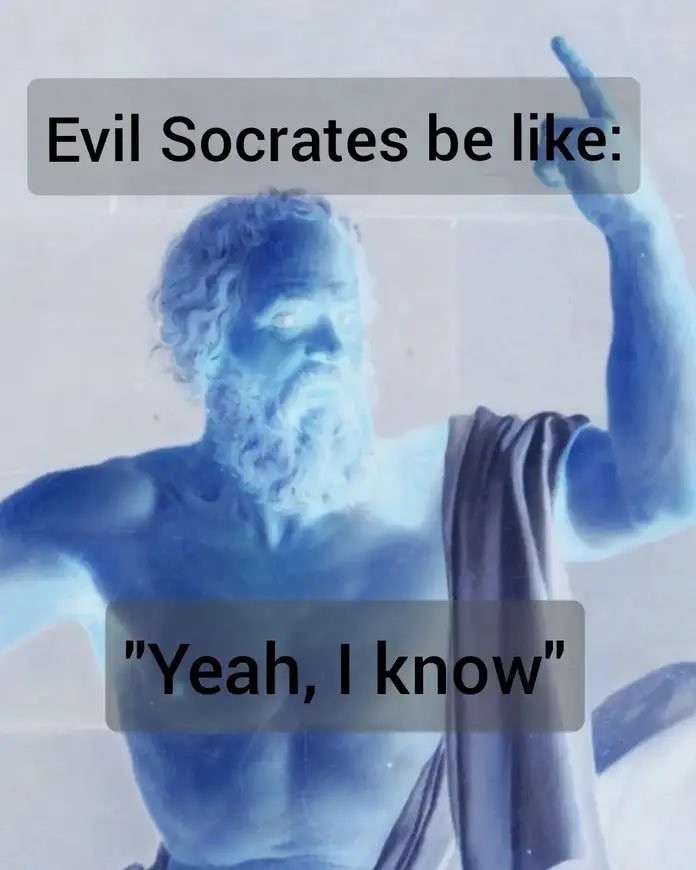
Good Socrates: “All we are is dust in the wind.”
Dust, wind. Bro.
Golden Wind? Stardust crusaders?

Evil Socrates? like the real one wasn’t an antidemocratic grifter that was held responsible for a coup that killed 10% of Athens.
I may be the dumbest man in Athens, but I still know a thing or two.