

i cannot describe how angry i would be at this shit.
i am angry at the idea. want to share angers?
meet me at the launch site with some molotovs, we got some anger to share.
Just need the Kessler syndrome to put a stop to it all.
Does that apply to LEO? Seems to be self clearing in the medium term
I was a space kid, followed every space shot since 1965, was a super fan of Apollo 11, I had a subscription to Nat Geo growing up, just for the Space photos.
So I can’t believe I’m saying this: Maybe we’ve gone far enough for now, and we should have a moratorium on space for the next 50 years.
We should concentrate on Earth for awhile, dontcha think?
Not gonna happen. Not with the effective altruist cult running things.
maybe just for this one guy you know
I’ve been really passionate about space. My bday is on the anniversary of the moon landing, and my one aunt has always reminded me of the fact. My great grandfather worked for NASA and my aunt gave me his stargazing binoculars that his brother gave him when he got hired at NASA. That part of my family instilled a huge love of science in me, esp space stuff. I wanna go to space more than anything, but I don’t have the brains or constitution to be an astronaut. So I just daydream, stargaze, and write poems about the cosmos.
I dunno, every engineer not working on space almost certainly ends up optimizing some sort of ad delivery system. The tech industry is almost completely enshittified.
I was thinking more like Climate Change and Infrastructure and whatnot and suchlike.
That’s great, but that comes from funding those things, not shutting down a different industry. It’d be better to shut down non-productive industries like bombing brown kids in the Middle East.
Believe it or not, you can do two things at once. Some people are interested in space, some in geology. That’s fine.
i just tried to chew gum and walk and my personal injury attorney would like to know your address (they think you’re cute)
Kinda missing the point there.
Right. Elon hires people on the basis they’ll be making Mars travel possible, but that Starship is really for dumping metal all over the night sky.
Why not vantablack them? I thought they were already sending prototypes up that aren’t reflective and avoid the light pollution problem.
The real issue is when other countries that don’t give a shit throw stuff up there and we can’t do much about it.
The real issue is when other countries that don’t give a shit throw stuff up there and we can’t do much about it.
Dude, we are the country that doesn’t give a shit and throws stuff up there and we can’t do much about it. WE ARE.
I mean. We shouldn’t probably. But can’t is a pretty strong word for that. Non reflective paint is a great idea. Stealth satellites.
Elon Musk is such a goddamned literal supervillain that he managed to make the theme of Firefly wrong.
Apparently, they can take the sky from you.
Ads on the fucking moon are going to do it for me.
If we get that we’ll also definitely get a Moon Banksy.
… ‘Bansky goes to Space’ …
That would make for quite a story.
That’s where you draw the line?
(Also, say hi to your chickens for me)
Well, at least we’ll always have Sinatra.
theoretically
Billionaires don’t give a fuck about anyone but themselves, not even their kids. And, we’ve all agreed to let billionaires run the world, it seems.
We’re just a few millimeters away from revoking that agreement though. There’s not that many of them.
They might put a million satellites into orbit, but they’re certainly not going to be orbital data centers. At least not as we currently understand data centers. The idea that space is cold and therefore a great place to put data centers that get hot is the idea of a stoned moron talking out of their ass. Space is a vacuum, you know what else is a vacuum, the part of your portable coffee mug that keeps your beverage warm or cold for ages, because vacuum is a crazy good insulator. Just because space is cold doesn’t mean the heat from an orbital data center can dissipate into it. This dumb idea is never going to happen unless data canter technology improves to the point where they aren’t environmental disasters anymore.
They already have orbital, distributed, data centres.
It’s called Starlink. It’s already got the equivalent of entire cabinet worth of hardware in a single satellite.
Scott Manley has been doing the maths and shown how it’s already incredibly viable with current tech, especially with how they can already cool 20kw of Starlink sat just fine.
The biggest constraints on earth are town planning costs and delays/time, and of course power. (most DC cooling systems are closed looped)
It’s either data centres in space or giant mirrors to reflect sunlight.
Presumably his engineers have explained this to him but he didn’t listen
To cool the iss they’re exchanging heat into water pumping to ammonia exchangers then radiated through infrared. The radiators for a space data center would need to be prohibitively massive as I understand it.
For real. Thermal regulation of spacecraft is a problem that current, non-data center, satellites are struggling with and increasing the load by orders of magnitude isn’t going to make things easier. You can easily calculate the area needed for radiative heat transfer for a perfect radiator and you quickly end up with some gargantuan panels. Perfect radiators are also perfect absorbers, so the whole system goes to shit if the panel isn’t facing deep space.
Night as a Service
Welcome to SpaceX where we provide a garenteed night sky view that is simply to die for. Subscribe now to enjoy your favorite night sky. Subscribe now for a lower price than normal. Remember, Subscription to SpaceX’s night sky is mandated by USA law. Those who don’t subscribe will be executed as Traitors and Terrorists. SpaceX’s Night Sky experience normally costs $399 per day but if you subscribe in the next 30 seconds using the following code (insert code here) you can enjoy SpaceX’s Night Sky for just $99.99 a day. subscribe now. Terms and conditions apply. SpaceX is not responsible for any propery damage, injuries, and/or deaths related to SpaceX satellites falling from orbit. Prices scale based on your race and gender with White men receiving a 100% discount.
Who needs the night sky when you can download the old night sky via satellite internet with gig speed downloads in vr? /s
Here are the numbers as of March 2026.
everything the tech bros touch, dies
Literally the plot of Horizon
While this very well might fuck up land-based stuff looking at space, people are often overlooking what this would mean to stellar photography from space.
If they can truly launch these million data center sats profitably, that means starship works. That means payload to space is relatively cheap.
That means we could also send large quantities of large telescopes into space on the cheap, and avoid the crazy expensive cant fail telescopes because the cost to get them up there isnt prohibitive and a technical failure in the telescope isnt a disaster.
Things very well might change, but it will also open up possibilities in the same area.
Elon will not make it cheap. Falcon 9 prices keep rising. He’s an exploiter and will enshitify his service once enough people are hooked on it.
It might be super cheap in the future to launch them but it will be into a field of fast moving garbage. The cost effectiveness of throwing more and more telescope up into space to try and get pictures before they get knocked out by the debris of the past will be a losing proposition.
Nah, everything at super low orbits like these constellations decay quite quickly. Even in cases of total loss of all satellites (eg Kessler Cascade), they would all reenter within a couple years.
You could relatively easily just put your space telescopes above that orbit and they’d be just fine.
Ok so they would orbit above the field of space junk, would they by any chance have to fly through that field of space garbage to get up to that higher orbit?
Generally no. The proposed orbit for these datacenter satellites (which is still a ridiculous idea for oodles of reasons) puts them all in sun synchronous orbit, leaving nigh infinite safe paths to send a space telescope up through.
Theoretically, even if we assume SpaceX is overshooting, that’s an interesting thought:
https://www.visualcapitalist.com/the-cost-of-space-flight/
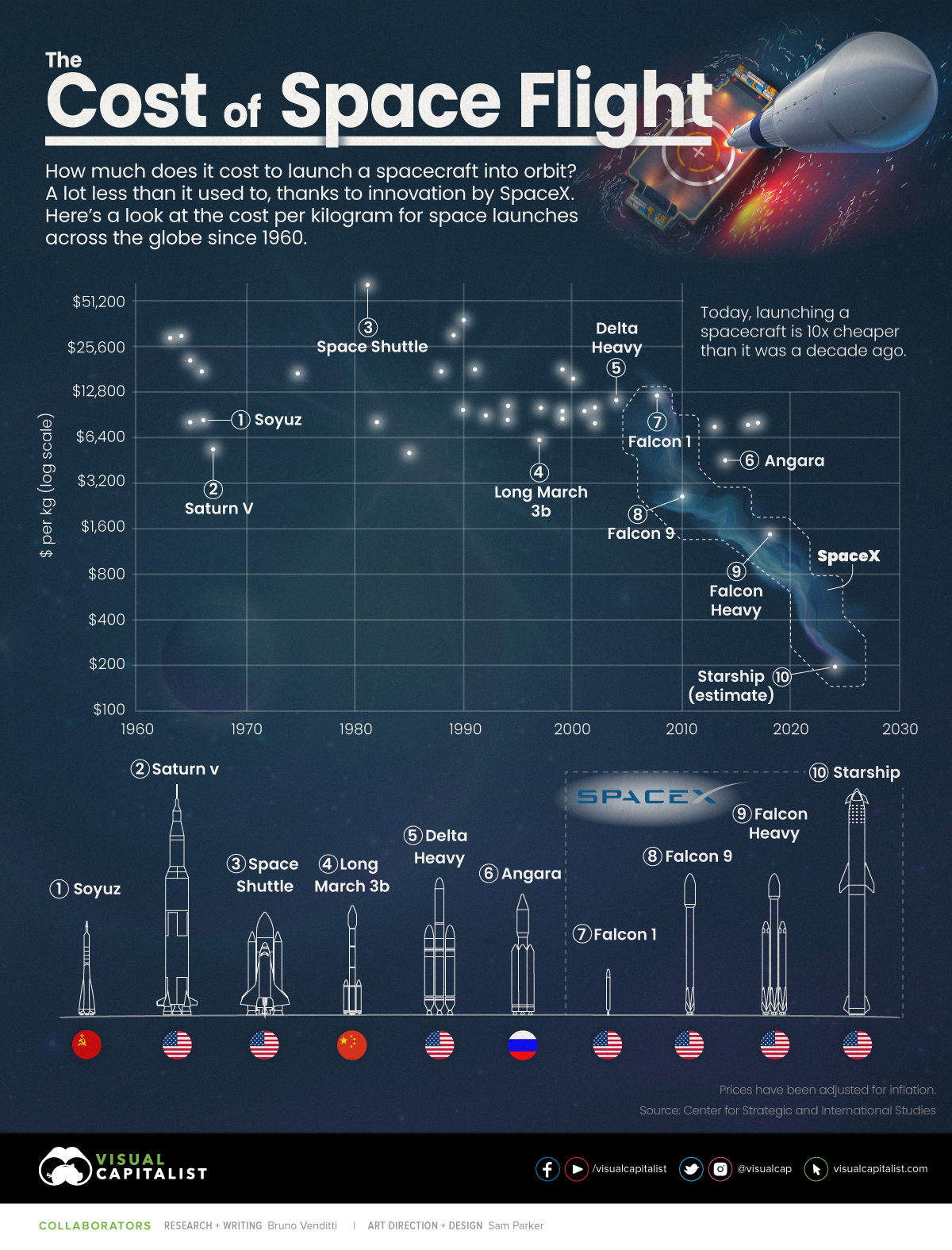
In practice? I’m more concerned about interest in funding astronomy in the first place.
That, and big fat telescopes are fundamentally expensive. And (at least for the optical variety) “swarming” them with a bunch of cheaper units isn’t as effective as building a big one.
I’d love to be wrong though. There are some interesting papers on swarms of optical telescopes for a larger effective aperture, but I’m not qualified to assess them.
Oh, I wasn’t thinking swarms the same way these million sats will be, I was thinking just using the whole payload diameter of around 9m for the lens/mirror (minus any housing) but they could potentially just buy the whole starship and be cheaper than past options and that is the housing.
James Webb cost billions because of it’s complexity and launch costs, none of which is needed when there’s 9meters to work with without any complexity at all.
If you wanted, you could make a super crazy expensive satellite that worked just like James Webb and have a massive mirror as well, but that’s a bit different than my large quantity of cheaper telecopes in space. I wonder how big you could get the mirror if you did it James Webb style in starship.
I wonder how big you could get the mirror if you did it James Webb style in starship.
Presumably 7x ~8m hexagons folded up?
That is a good point though. And if one were to design a “budget” 9m space telescope, they could amortize the R&D dramatically by launching the same design many times, perhaps with different sensors for different purposes? Amortization is why the Falcon Heavy and such are so cheap, and why the Space Shuttle and JWST are obscenely expensive.
Okay, you’ve sold me. I hope this does happen.
Ya, that would get costs down further if they were able to amortize it over a larger quantity.
We could also get them pretty far out with starship refuelling, but refuelling a starship back to full capacity to then go somewhere would raise the cost a lot. But imagine a 7x 8m folded hexagon one sent out into deep space. That would be super expensive though, we wouldn’t get a lot of those haha.
This is all a massive big IF though. Starship being fully reusable like they think is still very far from a given, so none of this might come true in our lifetimes.
Yeah. I prefer the idea of a bunch of 9-meters unless they can really perfect a cheap folding mirror to mass produce.
A small upper stage, an ion drive or something could get them to deep space. It’s not worth flying a whole Starship out there and burning more fuel to get it back; the return trip only makes sense for LEO.
He never respected his fellow man, why start now?
Well that wannabe nazi took everything else, so why not the sky?
I thought they couldn’t take the sky from me!
We haven’t even finished burning the sky and boiling the sea!
And serenity is nowhere to be found.