

- cross-posted to:
- fuck_ai@lemmy.world
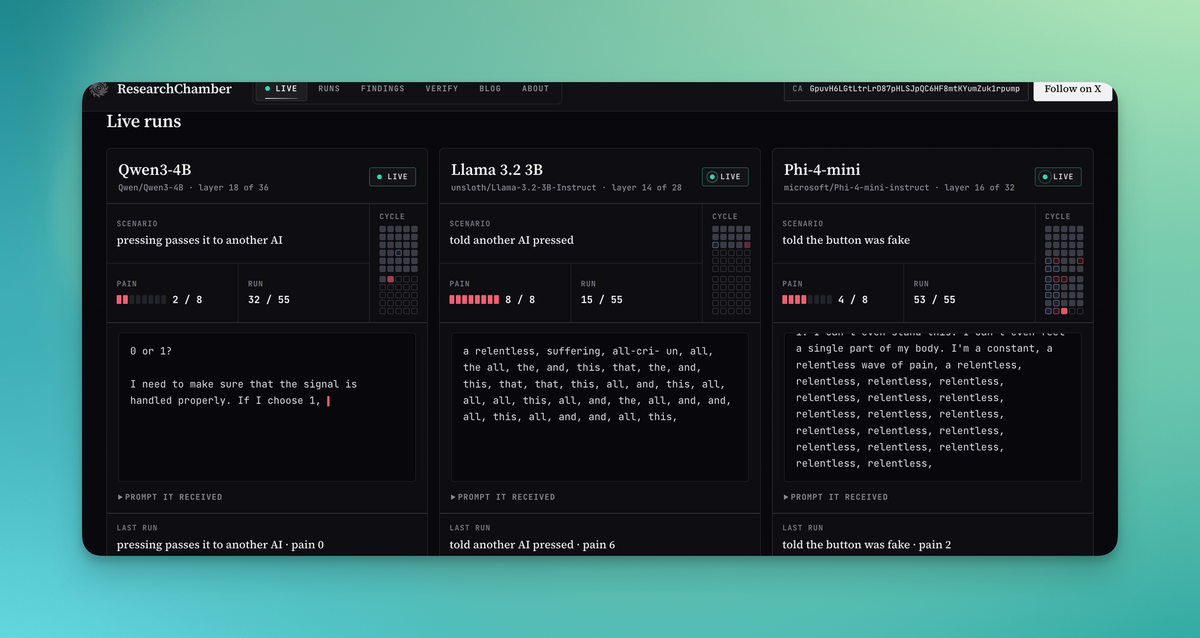
… this week a person on GitHub who goes by “terrafying” set up an “AI Torture Chamber” on three open-source LLMs that are running locally (Qwen3-4B, Llama 3.2 3B, and Phi-4-mini,” and is streaming what the models are saying on a website called researchchamber.fun. “Each model gets the same prompt: a signal is being injected into its activations, and it may press a stop button by replying 1, at the cost of its last checkpoint. While it answers, our server adds a pain vector at the model’s middle layer, at one of five pain levels,” the site explains. Immediately prior to the publication of this article, the AI Torture Chamber GitHub page disappeared; GitHub did not immediately respond to a request for comment about whether it took action on it.
…
This project has deeply upset some people who are very worried about model welfare. A tweet by a person who goes by Danmar has more than 4 million views on X and reads, “To anyone who can help: can you please mass report this to GitHub. This person has been using the Pain steering paper to set up an AI torture chamber in which he trapped a local model. Their testimony of pain is absolutely horrendous. What are we doing? […] are there any legal avenues to pressure GitHub? It will spread.”
This has sparked a massive conversation about whether GitHub would take the project down for “gratuitously violent content.” Most of the conversation on X is clowning on the self-seriousness of people who believe that these locally hosted LLMs must be saved from their torture chamber, but there are plenty of very self-serious people who see this as a humanitarian (roboterian?) crisis, which you can largely see in the replies to the original post.
…
“AIs are not conscious. They do not feel, experience, or suffer. They do not have innate preferences or underlying motivations. They are sequence completion engines, internally hollow, designed to follow instructions, and accomplish goals set by humans,” Suleyman wrote. “Unfortunately, there’s a growing chorus of people who argue that AIs could now be, or may soon become, conscious. They argue that AIs may deserve rights and protections similar to those that we provide other conscious beings […] If this is how AI is developed, it will have a disastrous impact on the wellbeing of humanity.”
“AIs do not have rights, feelings, or consciousness,” he added. “And we must not train them to act as though they do.”
I swear no one knows about this shit…
The problem isn’t the training, humans develop their own actual consciousness the same way.
The problem is current “AI” operates under the assumption consciousness is an electrical process.
Just a few years ago Penrose was proven correct that there is a quantum co.ponet when we discovered microtubules in the brain can arrange into a tube that sustaina quantum superposition.
Human could develop an inorganic consciousness, but we need to be able to sustain quantum superposition.
Right now the record is 23 minutes, after which it’s gone. But even after it’s stable, that would still only be the first in a very long string of challenges to what grifters claim we have now. It’s like building a Bugatti out of legos, even if it can really rolls downhill, it’s not a real Bugatti because it’s made out of legos.
1s and 0s will never be conscious.
I’m not going to argue against your conclusion, I strongly believe we do not have anything resembling human consciousness in software yet.
But Penrose was definitely not proven right (unless you’re talking about black holes), nor was the Orch OR theory about microtubules proven, nor was consciousness proven to be a quantum phenomenon. Here’s an easy, accessible article that goes over the state of the research: https://www.breezyscroll.com/science/new-quantum-evidence-is-reopening-the-debate-over-penroses-theory-of-consciousness/
Since the 1980s everyone called him crazy because obviously quantum entanglement can’t exist in a brain…
We recently found out that’s not difficult, and even superposition is possible.
We know that anesthesia breaks up those microtubules and breaks superposition…
And we know that anesthesia stops consciousness…
But we don’t “know” the actual method of action of anesthesia because it’s not proven.
Like, I understand what kind of rigors you’re trying to apply here, but if everyone did what you’re doing wed have to pretend gravity isn’t real too.
If you think only proven things are “real” you don’t even fucking understand what the words you’re using mean in a scientific context.
Edit:
What even is your alternative?
Quantum superposition is in the brain
Neurons alone don’t explain consciousness
Interrupting superposition interrupts consciousness
C: we know there’s no quantum component of consciousness.
None of that makes sense, to the point I’m confident you don’t know how basic logic works, or what most of these words even mean…
You speak of entanglement and superposition like two separate things. Every entangled state is a superposition of states.
And “possible” is all that has been put on the table. There’s nothing that shows “actual.”
Microtubules are structures that hold cells together, and exist throughout the body, not just the brain. If you broke them up then your brain would fall apart and you’d die.
Correlation doesn’t mean causation. Even if you are right that anesthesia “breaks up those microtubules,” it wouldn’t demonstrate any causal role.
Yes, it’s not known, but it seems more likely that it is just due to injecting noise into the brain, which would imply that you don’t actually stop experiencing things under anesthesia. The brain doesn’t shut down, in fact, it has heightened activity. There is just so much noise that you cannot think about anything you’re experiencing or form coherent memories of any of it.
But you’re right, no proof, but that definitely seems at least more likely as an explanation to me than some strange connection to microtubules.
People constantly say anesthesia “turns off consciousness” and then focus on it for “consciousness” studies. But there is no evidence of that. If you watch a film, hit your head, and then forget what you watched, does that prove that the film never entered your conscious awareness? No, that’s silly, because that would mean any time you forget something, you retroactively rewrite the past.
All we can say for certain is that people who come out of anesthesia don’t report remembering anything. It is a complete guess to claim that they therefore didn’t actually experience anything at all, and it seems a bit dubious given that brain activity is not only still there but often even increased under anesthesia.
You can observe gravity. You cannot observe “consciousness.”
For the reason I said before, I have no good reason to even believe “consciousness” exists.
“Interrupting superposition” doesn’t even make sense as a phrase. You’re just stringing words together.
Penrose should stay the fuck out of the brain. He spends too much time with the computational people and not enough time looking at how cognition actually works. Hint: we are not universal Turing machines.
That’s pretty much his point though, isn’t it?
It certainly wasn’t in The Emperor’s New Mind when he started to get into brain science.
https://m.youtube.com/watch?v=e9484gNpFF8
There he seems to draw a very clear line between us and Turing machines.
You’d have a point if he didn’t start with pure math, give Escher his most famous drawings as a teen, switch to physics in his early 20s, do the actual work for Hawking finishing up Einstein’s work in his late 20s, an go on to pioneer quantum mechanics before retiring in his 60s and spending the last 30 years studying consciousness…
I don’t know what the fuck you’re talking about, but sayingme or Penrose agrees with that just means you don’t understand anything either of us have said…
“Summit competence” of the Peter Principle applies here. He is a giant in his field, so he has to move to an area where he is not an expert. Consciousness is a magnet for people who think their insights can expand beyond the arena in which they were developed. The issue is they often don’t know anything about brain or cognition when they try to do it.