Well, you do need to consider things in context, right?
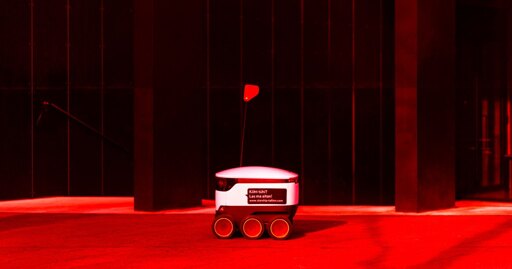
Captain_solanum is right about how math works. The thing to consider is the safety of these delivery bots relative to the alternatives. How often do delivery drivers get into/cause accidents? It’s not never, but without the actual numbers we can’t really say if these bots are more problematic.
It’s difficult to compare these two delivery methods because they’re inherently quite different, but ultimately that is what we have to do if we want to figure out which is actually more of a danger.
But accountability is really important here. If companies want to keep using tech this way, they need to be accountable for the actions of their technology. Because these devices exist in a physical world with real consequences. You cannot be allowed to get off the hook by saying “oops, just a glitch, it won’t happen again”.
Also, you called him an idiot, but you may have also missed his point. We could just not outright insult each other.
Yeah, accountability is the entire point. Are the corporations, executives, and shareholders going to be held responsible for this?
Also, every human driver is different. So it’s up to each driver as an individual to ensure they’re following traffic rules and driving safely. Human minds are also complex and capable of adapting to evolving circumstances, even at a moment’s notice, to deal with unexpected situations when they arise, such as near-miss emergencies.
Machines don’t have that; they’re algorithmic and deterministic, which means there will always be some possibility of events outside the scope of their programming.
Also, comparing the robots to human drivers isn’t a good comparison, because as far as we’re concerned the hardware and software are nearly identical between each robot. So if one of them was capable of causing a multi-vehicle accident, that means they all are.
So calculating probably using something similar to the manhours of each robot on the road is foolish. What they did was (incidents) ÷ (robots × time), to make it look like a comically small chance of having an accident.
A more accurate formula would be (1 – (incidents ÷ time))^(number of robots)^
And that gives you the probability of (time) elapsing without incident. The more robots there are, the smaller that number gets, meaning the likelihood of an accident increases with each additional robot. Not decreases.
So for example (1 – (1 accident ÷ 4 years))^(100 robots)^ = 0.75100
In other words, without a software update requiring significant technological improvements, with 100 of these robots on the road, the chances of going another 4 years without an accident is on the magnitude of 3.207 × 10^(-13)
I’ll leave you to determine what that makes the likelihood of x number of incidents per year.
You’re right that I didn’t have to call them an idiot though, I apologize for that. My temper was a bit spun up from arguing with trolls in a different thread, but I shouldn’t have let that seep out here.


Well, you do need to consider things in context, right?
Captain_solanum is right about how math works. The thing to consider is the safety of these delivery bots relative to the alternatives. How often do delivery drivers get into/cause accidents? It’s not never, but without the actual numbers we can’t really say if these bots are more problematic.
It’s difficult to compare these two delivery methods because they’re inherently quite different, but ultimately that is what we have to do if we want to figure out which is actually more of a danger.
But accountability is really important here. If companies want to keep using tech this way, they need to be accountable for the actions of their technology. Because these devices exist in a physical world with real consequences. You cannot be allowed to get off the hook by saying “oops, just a glitch, it won’t happen again”.
Also, you called him an idiot, but you may have also missed his point. We could just not outright insult each other.
Yeah, accountability is the entire point. Are the corporations, executives, and shareholders going to be held responsible for this?
Also, every human driver is different. So it’s up to each driver as an individual to ensure they’re following traffic rules and driving safely. Human minds are also complex and capable of adapting to evolving circumstances, even at a moment’s notice, to deal with unexpected situations when they arise, such as near-miss emergencies.
Machines don’t have that; they’re algorithmic and deterministic, which means there will always be some possibility of events outside the scope of their programming.
Also, comparing the robots to human drivers isn’t a good comparison, because as far as we’re concerned the hardware and software are nearly identical between each robot. So if one of them was capable of causing a multi-vehicle accident, that means they all are.
So calculating probably using something similar to the manhours of each robot on the road is foolish. What they did was (incidents) ÷ (robots × time), to make it look like a comically small chance of having an accident.
A more accurate formula would be (1 – (incidents ÷ time))^(number of robots)^
And that gives you the probability of (time) elapsing without incident. The more robots there are, the smaller that number gets, meaning the likelihood of an accident increases with each additional robot. Not decreases.
So for example (1 – (1 accident ÷ 4 years))^(100 robots)^ = 0.75100
In other words, without a software update requiring significant technological improvements, with 100 of these robots on the road, the chances of going another 4 years without an accident is on the magnitude of 3.207 × 10^(-13)
I’ll leave you to determine what that makes the likelihood of x number of incidents per year.
You’re right that I didn’t have to call them an idiot though, I apologize for that. My temper was a bit spun up from arguing with trolls in a different thread, but I shouldn’t have let that seep out here.