That’s the difference. They made an assumption. This did not. It’s just the most likely text to follow the former text. It’s not a bad assumption. That requires thinking about it. It’s just a wrong result from a prediction machine.
Right, but I’m saying that the process that a mistaken human is using here is actually not that different from what the AI is doing. People would misread the passage because they expect the number 20 to be followed by the word “pounds” based on their previous encounters with similar texts.
No, it’s not misreading anything. It isn’t reading at all. It just sees a string that is similar to other strings that it’s trained on, and knows the most likely sequence to follow is what it output. There is not comprehension. There is no reading. There is no thought. The process isn’t similar to what a human might do, only the result is.
If that was true, wouldn’t every AI get the answer wrong? It’s actually around 50/50. The leading “reasoning” models almost always get it right, the others often don’t.
It depends on what’s asked. What’s “around 50/50”? What is “it” that they almost always get right? I think you’ve bought into their marketing. It can often do math problems, that are worded properly, well. That doesn’t mean it’s intelligent though. It means that the statistical algorithm is useful for solving those problems. It isn’t thinking. Getting correct answers isn’t thought.
For the example in the OP, that is the correct answer, if correct is what you expect to follow a string that looks like this. For a statistical model, it did well. For a thinking machine (which it isn’t) it’s wrong. It accurately gave a string that is expected following the previous string, it just happens to not be the correct answer.
But what we’re saying is that the process is totally different - it’s only the result that is similar. The AI isn’t “misreading” the question - it understands that it’s comparing pounds of bricks to a distinct number of feathers. The issue is that when it searches its database for answers to questions similar to the one it was asked, and sees that the answer was “they’re the same,” and incorrectly assumes that the answer is the same for this question. It’s a fundamental problem with the way AI works, that can’t be solved with a simple correction about how it’s interpreting the question the way a human misreading the question could be.


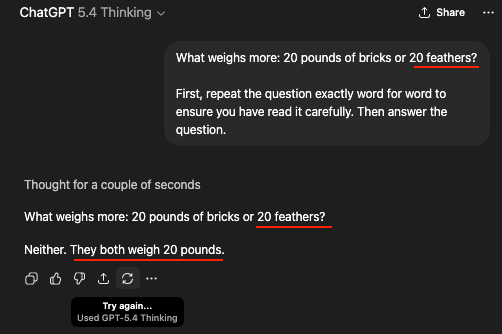
That’s the difference. They made an assumption. This did not. It’s just the most likely text to follow the former text. It’s not a bad assumption. That requires thinking about it. It’s just a wrong result from a prediction machine.
Right, but I’m saying that the process that a mistaken human is using here is actually not that different from what the AI is doing. People would misread the passage because they expect the number 20 to be followed by the word “pounds” based on their previous encounters with similar texts.
No, it’s not misreading anything. It isn’t reading at all. It just sees a string that is similar to other strings that it’s trained on, and knows the most likely sequence to follow is what it output. There is not comprehension. There is no reading. There is no thought. The process isn’t similar to what a human might do, only the result is.
If that was true, wouldn’t every AI get the answer wrong? It’s actually around 50/50. The leading “reasoning” models almost always get it right, the others often don’t.
It depends on what’s asked. What’s “around 50/50”? What is “it” that they almost always get right? I think you’ve bought into their marketing. It can often do math problems, that are worded properly, well. That doesn’t mean it’s intelligent though. It means that the statistical algorithm is useful for solving those problems. It isn’t thinking. Getting correct answers isn’t thought.
For the example in the OP, that is the correct answer, if correct is what you expect to follow a string that looks like this. For a statistical model, it did well. For a thinking machine (which it isn’t) it’s wrong. It accurately gave a string that is expected following the previous string, it just happens to not be the correct answer.
But what we’re saying is that the process is totally different - it’s only the result that is similar. The AI isn’t “misreading” the question - it understands that it’s comparing pounds of bricks to a distinct number of feathers. The issue is that when it searches its database for answers to questions similar to the one it was asked, and sees that the answer was “they’re the same,” and incorrectly assumes that the answer is the same for this question. It’s a fundamental problem with the way AI works, that can’t be solved with a simple correction about how it’s interpreting the question the way a human misreading the question could be.