Sometimes advances in technology do mean that things that they teach in school are outdated and can probably safely be removed.
I’d say cursive writing is one of those things. Writing in general is important, and obviously kids need to learn how to write upper case and lower case block letters. But, with computers everywhere, a whole secondary set of characters that is designed to be linked together seems useless.
I also do think that schools probably focus too much on memorization. I absolutely hated history in school because that’s how it was taught. Memorize the name of these battles and the dates and then regurgitate them for the test. I didn’t actually learn anything meaningful. What would have been much more useful and much more interesting would have been to learn more of the backstory. What was going on in the country that led it to go to war. Were they trying to distract from something, or get the people to unite against a common enemy? Were they supremely confident that they could easily win and gain important territory or resources? Were they backed into a corner?
I’d support not memorizing as many things because it’s true that you can look them up (of course, AI is not how you should ever look anything up because it might just ‘hallucinate’). I think most teachers would agree. But, it’s also a lot harder to write and grade a good test when you’re not doing names and dates. So, I assume that’s another big part of the reason that memorization is the focus.
They took out cursive from the curriculum for a while, but they are supposedly putting it back now. I think they are suggesting the brain learns a little differently with cursive so it’s still useful in that manner.
Also I think you’d enjoy the podcast I listen to, American History Tellers. I hated history for the same reasons you describe but this podcast really made me enjoy it. Usually they open a topic with something like “Imagine it’s in the late 1800s, and you are opening up shop. Times have been hard since [backstory], but you are getting by okay. You do worry about [current topic], and feel worse when you read today’s paper.” Even that small little setup kind of ropes you in to feel like it’s relatable.
I like that setup for learning history. Often history is told from the point of view of either an omniscient being who knows what everybody on every side is thinking, or from the point of view of the ruler of a country. It would be interesting to hear about it from the point of view of an informed but relatively powerless shopkeeper.
History is intentionally taught wrong I think. Nobody really needs to know the exact date that something happened (outside of a few key events). What actually matters is what timeframe it happened in, what events led up to it, and what the consequences were. The “why” behind the events. History should be taught like his-STORY because it is a story. One of my favorite middle school history teachers taught us history as if it was a story book and the historical figures were characters, which made it interesting to listen to, while also being contiguous.
By teaching history as a disjointed series of dates and events, schools fulfill their obligations to have a class be taught without actually teaching the critical thinking people need to understand current events. How much of this is intentional to cause students to grow into adults who vote against their own interests, or simply a result of paying teachers less than McDonald’s workers I do not know.
Horace Mann, the father of public education, was a Puritan. An exerpt from a little article about Horace Mann here:
"It’s worth reminding ourselves now about the key characteristics of the industrial era, and how we can see them manifested in the education system that continues to operate across America to this day:
Schools focus on respecting authority
Schools focus on punctuality
Schools focus on measurement
Schools focus on basic literacy
Schools focus on basic arithmetic
Notice how these reinforce each other. You enter the system one way, and are crammed through an extended molding process. The result? A “good enough” cog to jam into an industrial machine."
But school isn’t just preparation the “industrial machine”. It also serves as a propaganda machine. The master of Nazi propaganda, Joeseph Goebbels, saw schools as a place to indoctrinate the youth. That’s the purpose of history class in public education. To build the mythos, to encourage loyalty, to tell stories of brave soldiers fighting the ever-present enemies of the state.
Based on my kid’s experience, the very particular details aren’t required, though enough to prove you aren’t just completely fabricating things.
Knowing roughly which century and what region things happened, and being called upon to take a cited scenario and then compare and contrast with a scenario of the student’s choice, constrained to a general region and area, that’s the nature of the history class.
I’m overall actually pleased at the blend of knowing enough but not getting carried away in trivial minutia. Has to be somewhat tethered because the teacher has to have some way of knowing whether they actually studied or just vaguely make up thoughts that sound right.
But it takes a while for grades to come back and there aren’t many grades, because it’s pretty much entirely essay, entirely handwritten (because typed is too risky for AI interference).
No complaints from my kid about “computers can do this anyway”, because it’s understood that we do “stupid human tricks” to foster our ability to think, so it sucks, but fine. A bit of the “I’m never ever going to use this” for the advanced math and chemistry, which is accurate, but balanced against “well we can’t specifically tackle what you will use, but we can vaguely get your brain to use these topics to get used to reasoning through things in ways you’ll have to reason through real stuff”.
You know they don’t teach typing anymore either.
Yeah Ive got 3 nieces and a nephew. None of them can use a keyboard properly. They type with their index fingers.
I think cursive was designed for feather dipped ink pens so they didn’t have to be lifted because that often causes blobs.
It’s also something you can learn easily on the side.
I think it’s primary benefit is if it’s taught to kids, it helps them develop fine motor skills.
We may see a decline in art drawing abilities due to this. (Among other issues that would contribute to this).
Poorer surgeons.
Loss of quality Craftsmanship in many detail oriented fields.
We learn skills like this better as kids.
That’s my only real argument why it should still be taught.
Kids don’t really learn fine motor tool manipulation skills like this in their other activities.
Human hands are one of our greatest strengths. Shame to not develop this better in kids.
I think you’re reaching when you think that no cursive writing will mean poorer surgeons. Is there any evidence to back that up, or is it just supposition?
Besides, less time spent on cursive writing could be sent on drawing or painting. Or, the kids could have more time off which they could use to play video games, which give them better hand-eye coordination making them better surgeons later in life.
How old are they? I was never taught typing, just kinda made it up myself. I tried to learn a few times with Mavis Beacon and stuff, but I can never get the “proper” way to stick.
Oldest niece recently 18, then 16 and a 14 year old. Nephew is like 11 I think.
All the girls are from my sister and nephew from my brother. I’m pretty sure that’s close to their accurate ages.
But yeah they don’t teach typing anymore and they expect kids to just learn it on their own but a lot of people don’t have home computers. Kids use phones and tablets.
But I can tell you at college level, most writing has to be typed out.
So it’s really setting them up for struggling
I remember typing class. I thought it was super boring and frustrating.
I never would have learned to type properly if I hadn’t been forced.
I’m sure that’s true for most kids/people.
The thing that helped me improve my skills the most was social media. Specifically messengers.
But kids don’t use computers anymore for sending messages back and forth.
I honestly think when these kids get into the workforce, there is going to be some serious problems.
They can’t use regular computers very well and they can’t type.
When did you go to school? I don’t think I’d consider everything about the education I received to be ideal but by the time I was in high school it was very much not about memorisation and history in particular was taught basically exactly like what you described as what you would have preferred it to have been.
Cursive was interesting. I went to a lot of schools because my family moved around a lot. In Primary school, in the 90s cursive was inconsistently taught, and inconsistently valued and by the time I had reached the 6th grade it was simply considered obsolete and sometimes even actively prohibited because they wanted you to dispense with the idea.
As I moved to new schools around this time I noticed nobody else did cursive, also my cursive looked bad since I hadn’t really mastered it and also been taught about 3 or 4 different varieties of the “correct” way at different schools with no acknowledgement of there being different systems in existence. So I gave it up and printed like all my compatriots but then in French class in highschool the text book had a section on french culture showing “french writing” that they presumably taught there and I liked how it was kind of more complicated and daintier than the versions I’d learned so I tried to imitate those stylistic differences for fun and out of boredom in class. I now voluntarily write cursive for the hell of it because it’s more interesting and fun to do. I do this in my own bastardised hand learned in multiple different schools with multiple half remembered “standard” systems plus a few elements of the French system that I cherry picked from that text book all those years ago and a couple of things I looked up online because I wondered if some things might look better from other systems. Don’t know why, just kinda like it.

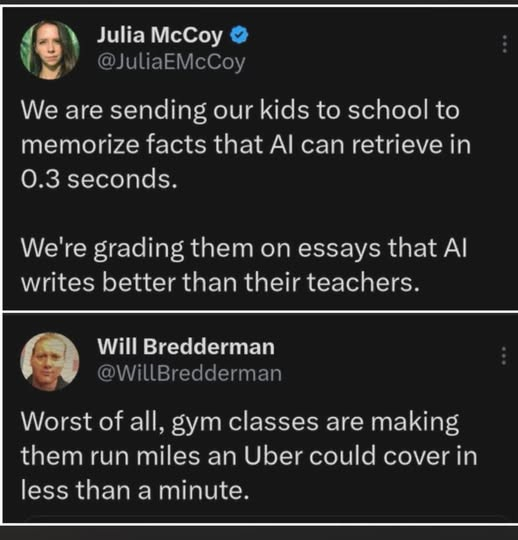
Sometimes advances in technology do mean that things that they teach in school are outdated and can probably safely be removed.
I’d say cursive writing is one of those things. Writing in general is important, and obviously kids need to learn how to write upper case and lower case block letters. But, with computers everywhere, a whole secondary set of characters that is designed to be linked together seems useless.
I also do think that schools probably focus too much on memorization. I absolutely hated history in school because that’s how it was taught. Memorize the name of these battles and the dates and then regurgitate them for the test. I didn’t actually learn anything meaningful. What would have been much more useful and much more interesting would have been to learn more of the backstory. What was going on in the country that led it to go to war. Were they trying to distract from something, or get the people to unite against a common enemy? Were they supremely confident that they could easily win and gain important territory or resources? Were they backed into a corner?
I’d support not memorizing as many things because it’s true that you can look them up (of course, AI is not how you should ever look anything up because it might just ‘hallucinate’). I think most teachers would agree. But, it’s also a lot harder to write and grade a good test when you’re not doing names and dates. So, I assume that’s another big part of the reason that memorization is the focus.
They took out cursive from the curriculum for a while, but they are supposedly putting it back now. I think they are suggesting the brain learns a little differently with cursive so it’s still useful in that manner.
Also I think you’d enjoy the podcast I listen to, American History Tellers. I hated history for the same reasons you describe but this podcast really made me enjoy it. Usually they open a topic with something like “Imagine it’s in the late 1800s, and you are opening up shop. Times have been hard since [backstory], but you are getting by okay. You do worry about [current topic], and feel worse when you read today’s paper.” Even that small little setup kind of ropes you in to feel like it’s relatable.
I like that setup for learning history. Often history is told from the point of view of either an omniscient being who knows what everybody on every side is thinking, or from the point of view of the ruler of a country. It would be interesting to hear about it from the point of view of an informed but relatively powerless shopkeeper.
History is intentionally taught wrong I think. Nobody really needs to know the exact date that something happened (outside of a few key events). What actually matters is what timeframe it happened in, what events led up to it, and what the consequences were. The “why” behind the events. History should be taught like his-STORY because it is a story. One of my favorite middle school history teachers taught us history as if it was a story book and the historical figures were characters, which made it interesting to listen to, while also being contiguous.
By teaching history as a disjointed series of dates and events, schools fulfill their obligations to have a class be taught without actually teaching the critical thinking people need to understand current events. How much of this is intentional to cause students to grow into adults who vote against their own interests, or simply a result of paying teachers less than McDonald’s workers I do not know.
It’s intentional, ofc.
Horace Mann, the father of public education, was a Puritan. An exerpt from a little article about Horace Mann here:
"It’s worth reminding ourselves now about the key characteristics of the industrial era, and how we can see them manifested in the education system that continues to operate across America to this day:
Notice how these reinforce each other. You enter the system one way, and are crammed through an extended molding process. The result? A “good enough” cog to jam into an industrial machine."
But school isn’t just preparation the “industrial machine”. It also serves as a propaganda machine. The master of Nazi propaganda, Joeseph Goebbels, saw schools as a place to indoctrinate the youth. That’s the purpose of history class in public education. To build the mythos, to encourage loyalty, to tell stories of brave soldiers fighting the ever-present enemies of the state.
Based on my kid’s experience, the very particular details aren’t required, though enough to prove you aren’t just completely fabricating things.
Knowing roughly which century and what region things happened, and being called upon to take a cited scenario and then compare and contrast with a scenario of the student’s choice, constrained to a general region and area, that’s the nature of the history class.
I’m overall actually pleased at the blend of knowing enough but not getting carried away in trivial minutia. Has to be somewhat tethered because the teacher has to have some way of knowing whether they actually studied or just vaguely make up thoughts that sound right.
But it takes a while for grades to come back and there aren’t many grades, because it’s pretty much entirely essay, entirely handwritten (because typed is too risky for AI interference).
No complaints from my kid about “computers can do this anyway”, because it’s understood that we do “stupid human tricks” to foster our ability to think, so it sucks, but fine. A bit of the “I’m never ever going to use this” for the advanced math and chemistry, which is accurate, but balanced against “well we can’t specifically tackle what you will use, but we can vaguely get your brain to use these topics to get used to reasoning through things in ways you’ll have to reason through real stuff”.
You know they don’t teach typing anymore either. Yeah Ive got 3 nieces and a nephew. None of them can use a keyboard properly. They type with their index fingers.
However they end up getting the data into the computer, it’s still in the computer. Cursive just isn’t useful in that world.
I think cursive was designed for feather dipped ink pens so they didn’t have to be lifted because that often causes blobs.
It’s also something you can learn easily on the side.
I think it’s primary benefit is if it’s taught to kids, it helps them develop fine motor skills.
We may see a decline in art drawing abilities due to this. (Among other issues that would contribute to this).
Poorer surgeons.
Loss of quality Craftsmanship in many detail oriented fields.
We learn skills like this better as kids.
That’s my only real argument why it should still be taught. Kids don’t really learn fine motor tool manipulation skills like this in their other activities.
Human hands are one of our greatest strengths. Shame to not develop this better in kids.
I think you’re reaching when you think that no cursive writing will mean poorer surgeons. Is there any evidence to back that up, or is it just supposition?
Besides, less time spent on cursive writing could be sent on drawing or painting. Or, the kids could have more time off which they could use to play video games, which give them better hand-eye coordination making them better surgeons later in life.
How old are they? I was never taught typing, just kinda made it up myself. I tried to learn a few times with Mavis Beacon and stuff, but I can never get the “proper” way to stick.
I had a typing class in middle school about 18 years ago (jfc)
Oldest niece recently 18, then 16 and a 14 year old. Nephew is like 11 I think.
All the girls are from my sister and nephew from my brother. I’m pretty sure that’s close to their accurate ages.
But yeah they don’t teach typing anymore and they expect kids to just learn it on their own but a lot of people don’t have home computers. Kids use phones and tablets.
But I can tell you at college level, most writing has to be typed out.
So it’s really setting them up for struggling
I remember typing class. I thought it was super boring and frustrating.
I never would have learned to type properly if I hadn’t been forced.
I’m sure that’s true for most kids/people.
The thing that helped me improve my skills the most was social media. Specifically messengers.
But kids don’t use computers anymore for sending messages back and forth.
I honestly think when these kids get into the workforce, there is going to be some serious problems.
They can’t use regular computers very well and they can’t type.
Basically boomer level tech skills.
When did you go to school? I don’t think I’d consider everything about the education I received to be ideal but by the time I was in high school it was very much not about memorisation and history in particular was taught basically exactly like what you described as what you would have preferred it to have been.
Cursive was interesting. I went to a lot of schools because my family moved around a lot. In Primary school, in the 90s cursive was inconsistently taught, and inconsistently valued and by the time I had reached the 6th grade it was simply considered obsolete and sometimes even actively prohibited because they wanted you to dispense with the idea.
As I moved to new schools around this time I noticed nobody else did cursive, also my cursive looked bad since I hadn’t really mastered it and also been taught about 3 or 4 different varieties of the “correct” way at different schools with no acknowledgement of there being different systems in existence. So I gave it up and printed like all my compatriots but then in French class in highschool the text book had a section on french culture showing “french writing” that they presumably taught there and I liked how it was kind of more complicated and daintier than the versions I’d learned so I tried to imitate those stylistic differences for fun and out of boredom in class. I now voluntarily write cursive for the hell of it because it’s more interesting and fun to do. I do this in my own bastardised hand learned in multiple different schools with multiple half remembered “standard” systems plus a few elements of the French system that I cherry picked from that text book all those years ago and a couple of things I looked up online because I wondered if some things might look better from other systems. Don’t know why, just kinda like it.