My question is always how the hell are you going to cool them. Do you know hard it is to move heat in a vacuum?
The problems; plural; is that the person who popularized the idea of data centers in space has little to zero understanding of any of the space sciences and yet owns and directs one of the world’s largest, and privately owned, aerospace companies with massive government contracts that splits its time with their own AI work.
We already have data centers in space.
Oh? Good. Problem solved then.
User name checks out, though
deleted by creator
Please tell me you aren’t serious.
They are completely cereal!
Super cereal
With extra milk
dude! how do you expect anyone to answer if you don’t say surely you can’t be?
I am serious, and don’t call me dude!
Dude stop
Easy, just create a long heat sink and dangle it in the earth’s atmosphere. Now we are winning!
From that to a space elevator…
How would you power them?
The surface area of solar panels exceeds the surface area needed for radiators to cool everything.
In space I would imagine you’d find the perfect sandwich ratio. One bun solar, one bun radiators, the meat being the racks.
Raditors. Starlink v3 can in theory already shed (edit 20) kW of heat. But they would need to figure out how to 5x that and keep things profitable.
It would be 20kW for each rack or two. The types of data centre deal they talk about these days are measured in GW of compute. That’s 50,000x just for 1GW.
These aren’t big things, they’re small satellites. They’re going to be ~100kW. They only need to 5x the existing radiator they think will work.
With radiators just like with every existing satellite system.
https://youtu.be/DCto6UkBJoI&t=12m57s
Very large scale datacenters would likely have some nasty fluid handling problems to solve.
I’ll just note that I am not a fan of putting internet infrastructure in space. I think polluting the upper atmosphere with a bunch of metals every time a satellite deorbits will certainly have negative consequences. So IMO space should be limited to things we can’t do with earthbound infrastructure.
Removed by mod
And you can only build so many of those radiator panels before you start running into congestion problems. You don’t want them radiating onto each other.
Removed by mod
The area of radiator needed directly corresponds to the amount of power harvested by the solar panels. It doesn’t matter what the load is. So a compute frame with the same amount of solar panels as the space station would need approximately the same radiatot area as the ISS, unless you are bringing nuclear power into the mix.
I agree that space based datacenters are a bad idea, but the thermals really are not the gotcha people are making them out to be.
The solar panels needed is another problem for the space data center fantasy. Once you put together all the mass over enough surface area to make it work, you would blot out the sun worldwide.
They’re called fins. Not panels.
Removed by mod
Removed by mod
Yeah the amount of heat a data center vs a satellite your going to super heat the space in that orbit over time. It they are geostationary then its even harder as the the data center doesn’t move away from the heat.
Geostationary satellites are not standing still. They’re orbiting the Earth at the same rate that it rotates “beneath” them.
Um, it doesn’t make the data center in orbit thing make sense, but a geostationary satellite absolute moves at high speed and does not stay in the same place in space.
The heat would be moving at the same speed. Though, that does mean it wouldn’t be any better in any other orbit.
Again, it doesn’t help the case, but just… no. The heat gets out of the spacecraft by radiating, and radiation doesn’t move in a circular orbit around Earth, it moves at speed of light outwards from where it started.
Thermal energy is primarily dissipated as infrared light which moves at the speed of light. There is no way for space to accumulate heat. If that were the case the entire solar system would be unlivable. The IR emitted by satellites is truly negligible in comparison to the electromagnetic radiation emitted by the sun.
Super heat what in that space? The point is there’s nothing to transfer heat to. All you can do is radiate infra-red light.
Radiators in space work by radiating electromagnetic energy(light). Heat can only accumulate in matter, not in space, so that is definitely not one of the things we need to worry about.
geostationary then its even harder as the the data center doesn’t move away from the heat.
Geostationary would leave the satellite in shadow anytime it was night time over the part of the earth since a geostationary orbit is stationary in the sky over a given point at the equator.
That doesn’t solve any of the cooling problems just saying that you do get some shadow at geostationary orbits.
There are other orbits that get less shadow though.
It’ll be in shadow at midnight, yes, but not necessarily at any other time. Geostationary orbit is at about 7x the radius of the earth.
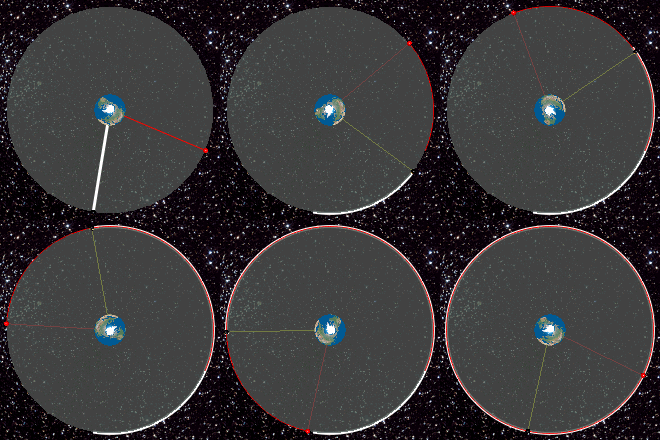
As such, the period when in will actually be in shadow is only a short period directly behind the planet.
A radiator. Next question?
What’s going to be performing convection to dissipate heat from the radiator in a manner to support the heat generated by an AI data center?
Obnoxious as he seems to be, he’s actually right, there will be no convection, but they’d radiate heat in a vacuum, by IR IIRC.
You’d need an enormous radiator to move the heat a data center puts out. Not even all the billionaires put together could afford that.
Sure, the idea is as bad as solar roadways. It’s actually kind of impressive to come up with an idea that bad.
To do that they’d have to be filled with something other than something water based to be able to do that over a large area which would require constant maintenance to do so. It’s not easily feasible and I doubt people who want to do this or defend it realize that. I have to look it up but it takes Anhydrous Ammonia to perform that in the ISS. Like this is a bad idea and it fries my brain people trying to defend this.
Yeah as I have already said, it’s kind of impressive how bad the idea is, I mean how can it be worse…
What part of radiator don’t you understand?
What you don’t understand is the size requirements those radiators would need to have to cool an entire data center.
It’s conserved.
Right. Exactly zero understanding on your part.
Zero effort shit post. Cool.
Do you ever make posts that demonstrate what your opinions are or what your own thoughts are or do you just like to talk about other people and put them down cuz it makes you feel better?
Tell me you don’t know how radiators actually work without telling me. They dissipate heat via convection through the air surrounding them or gasses in general. What does space lack a significant amount of?
Yeah so there is some confusion here. The are radiators on cars or in houses, but those are more accurately heat exchangers. Then there are things like heat lamps, which are really IR radiators that convert electricity to infrared light that feels hot.
Most of the heat you feel at a camp fire is radiant from the flame, unless you are down wind and feeling some convective heat, but most of that heat goes straight up with the smoke.
There’s a difference certainly but do you think the people who seem to be floating this idea know the difference?
Hard to say, but they’ve been using
resistiveradiative cooling In space a long time.Also a tech ingredients made a neat video about building one and radiating heat out into space from the ground. It was cool to see what happened when it was cloudy and stopped working.
Radiators dissipate heat through…wait for it…
Radiation.deleted by creator
Do you know how BIG they would have to be to dissipate a data center worth of heat to keep it as cool as on earth?
Do you?
Do you know how much heat they would need to retain?
Right… and a carpet is a pet you keep in your car, got it.
They’re a great idea if you happen to own a company making AI, a company making rockets, and a company controlling public opinion.
I envision a future so shitty that people are willing to physically destroy data centers in self-defense. Putting them in space is a really good way to combat that.
Putting them in space also puts them technically outside of the legal jurisdiction of any country. I figure fElon probably assumes that means said servers can never be subpoenaed.
I mean a data center barge or one in Antarctica would do much the same and be wildly cheaper and (relatively) more practical.
But those aren’t as “cool”
Subpoena the ground stations if that was true?
Oh yeah it’s totally a bullshit argument, it wouldn’t hold water in any court. Hell if nothing else, the ground stations like you said, or the country whose airspace the center exists over, would be in jurisdiction.
But I do believe that Musk believes it’s a get out of jail free card.
Agreed. The US can access/subpoena any data it wants from US companies, even if the servers they host the data on are in Europe or Asia or…
It doesn’t matter where the servers and the data is located. It matters who posses (or controls the access) to it.
Little Space James
Oh great, AI generated CSAM from space…
Putting data centers in space is a good way to keep people from destroying them. Thermodynamics on the other hand, will have a field day with them.
Keep people from destroying data centers by having them destroy themselves? Is this some sort of zen koan?
Have to destroy the rockets that are used to maintain them then and just wait.
They aren’t maintained. They’re a constellation of small satellites in LEO like starlink that just go up and eventually come down.
If they’re too far up latency would be too high
No one is repairing any of these starlink type dishes.
Wasn’t it recently proven that the metals introduced into the upper atmosphere by satellites burning up depletes ozone? Its not a problem yet but maintaining constellations on the scale of cumulative several gigawatts of data centre would leave several tons of satellite burning up every single day. CFC Ozone hole is gonna look like a cloudy day in comparison.
I just wanted to add another note
Even if this ozone thing turns out to not be true, there are still all sorts of other things being burned up in the atmosphere that can have other potential effects. It all needs to be studied given the size of these constellations.
I wouldn’t be surprised if 50-60 years from now, if there is a real issue, that it eventually comes out that SpaceX or other mega constellation companies figured out it would be a problem, and just said nothing. Much like how big oil new CO2 was a problem forever ago and hid it.
I don’t think anything was proven yet, but something came out saying it warranted more studying?
Satellites might need to be redesigned around it in the future and more studies should be done.
Pastry in spaaace! Still, eventually they will stop working.
If they stop working they will just de-orbit it early, or if they can’t cause it’s really broken, they’ll just wait the ~5-10 years to come down on it’s own.
deleted by creator
Also the whole being a vacuum thing makes heat dissipation much more difficult.
And an excellent way to scam a little. And fleece the flock
That’s an insightful way of putting it, 10 points.
There was one study where they set the price of launching at 0 and it’s still a lot more expensive to use data centers in space.
For anyone who doesn’t know, this is because space is an absolutely terrible place to put computers. Getting power is actually the easiest problem to solve, and is still really hard, because building any kind of infrastructure in space is hard. Then you’ve got all that radiation you have to shield against because you’re no longer protected by the Earth’s atmosphere, and worst of all you’ve got the cooling problem because Jesus fucking Christ, space is not cold!
This is why I get annoyed every time a scifi movie shows people freezing to death in space. Because it leads to this level of mass delusion and then suddenly it matters and everyone just unquestioningly believes the lie that space is cold. Space is a vacuum. A vacuum is what your Contigo travel mug uses to keep your coffee scalding hot after four hours. If vacuums are that good at keeping something hot when it naturally wants to get colder, think about what they’ll do to something that is actively generating heat. All of your components are going to cook.
There are proposals to put data centres at the bottom of the ocean that are substantially more credible than this idiocy.
I’m always annoyed that people don’t get that space isn’t cold or hot, since heat is a property of matter, and that’s exactly what a vacuum doesn’t have. Your travel mug example is great. I’m going to start using it.
That’s because science literacy is pretty low.
And to be fair, the average person doesn’t need to understand vacuum thermodynamics. The issues is when a few of those “average people” are now billionaires making unilateral decisions, surrounded by yes men and feeds instead of experts informing them of reality.
Maybe we should put datacenters on Mars, to warm it up.
I’d rather on the moon. It’ll melt all the cheese and there’ll be fondue lakes!
Whatever you do, don’t put it on Jupiter! It’ll get more stupider!
What if we put it on Uranus though?
There should be a reductio ad uranum for talks about space, similar to the reductio ad hitlerum for political discussions.
Tell me if I’m wrong, but with the shielding they have on the ISS doesn’t it have issues that consumer grade computers they use last a few months due to various radiation and heat that they die? So an AI data center is going to be insane to protect long enough to make its components useful.
Yep. Radiation is deadly to computers, and without the atmosphere to protect you there is a LOT of radiation in space.
I don’t know if it would work but… Could an infrared laser expel enough heat?
You need to think about how an infrared laser works. You’re taking electricity, converting it into light and then focusing the light.
So you’d need to take the heat from your GPUs, inefficiently convert it into electricity (a lot of it would remain as heat), then inefficiently convert electricity into light (much of the electricity would turn back into heat in this process) and then focus the light away from the space data centre.
Now, we already have a process for moving heat away from things as infrared light, without going through all those steps (which would just reduce the efficiency of the process). It’s called a radiator, and it’s how we cool things in space. That’s literally where the name comes from; they radiate heat away as infrared light. That’s why hot things glow in thermal cameras.
It is incredibly inefficient. Radiation (ie, infrared light) is, by far, the worst way of cooling things. But in space its the only option you have, because there’s no convection or conduction across vacuum.
A top end GPU puts out about 1,000 watts of waste heat. The entire International Space Station has enough cooling for 14 of those, if it was doing nothing else whatsoever. An average server rack contains 72. The ISS cost $100 billion dollars. So at a minimum you’re looking at around $500 billion to put one single server rack in space. And that’s before accounting for the heat from the sun, which we can’t avoid because we need solar power to run this thing. So probably closer to a trillion. In other words, twice the already ludicrous price tag of Sam Altman’s “Stargate” project. For a single server rack.
But in space its the only option you have
Hmm, this has me thinking about the stealth ships in The Expanse. The engineering needed to make it work makes me want to cry, but in principle you could run a Peltier cooler with a swappable heat sink.
To be clear, I don’t think this is a viable option, but it’s interesting to think about.
Basically the way you would make a stealth spaceship would be by focusing as much as possible on energy efficiency. At every juncture you would try to use as little power as possible, and use every bit of it as efficiently as possible, so that you’re not remitting waste. That waste, in the form of heat, radio waves, etc, is what gets you spotted.
You could also run heatsinks temporarily for enhanced stealth as you suggest, then open up radiators to cool them - or eject them - once it’s safe to do so.
(For the Elite: Dangerous players, yes, that game got it right.)
You could cool them through radiative panels but you would need quite big panels to radiate away the heat a data center produces.
The entire ISS has 14GW of cooling (and a lot of that just goes towards keeping the sun from cooking it). A single server rack can produce around 72GW of heat.
The ISS cost about $100 billion.
Basically, if you took the entire budget of Sam Altman’s “Stargate” project (money that, to be clear, he does not have and will not get) and put it into space data centres you might, optimistically, put one rack in space.
Most data centres have dozens to hundreds.
You’re absolutely correct, but “quite big” might be the single biggest understatement I’ve seen in my life.
Project Icarus it was called, the fourth space program of that name and the first for which it was appropriate. Long before Jacob’s parents were born—before the Overturn and the Covenant, before the Power Satellite League, before even the full flower of the old Bureaucracy—old grandfather NASA decided that it would be interesting to drop expendable probes into the Sun to see what happened.
They discovered that the probes did a quaint thing when they got close. They burned up.
In America’s “Indian Summer” nothing was thought impossible. Americans were building cities in space—a more durable probe couldn’t be much of a challenge!
Shells were made, with materials that could take unheard of stress and whose surfaces reflected almost anything. Magnetic fields guided the diffuse but tremendously hot plasmas of corona and chromosphere around and away from those hulls. Powerful communications lasers pierced the solar atmosphere with two-way streams of commands and data.
Still, the robot ships burned. However good the mirrors and insulation, however evenly the superconductors distributed heat, the laws of thermodynamics still held. heat will pass from a higher temperature to a zone where the temperature is lower, sooner or later.
The solar physicists might have gone on resignedly burning up probes in exchange for fleeting bursts of information had Tina Merchant not offered another way. “Why don’t you refrigerate?” she asked. “You have all the power you want. You can run refrigerators to push heat from one part of the probe to another.”
Her colleagues answered that, with superconductors, equalizing heat throughout was no problem.
“Who said anything about equalizing?” the Belle of Cambridge replied. “You should take all excess heat from the part of the ship were the instruments are and pump it into another part where the instruments aren’t.”
“And that part will burn up!” one colleague said. “Yes, but we can make a chain of these ‘heat dumps,’” said another engineer, slightly more bright. “And then we can drop them off, one by one …”
“No, no you don’t quite understand.” The triple Nobel Laureate strode to the chalkboard and drew a circle, then another circle within.
'Here!" She pointed to the inner circle. “You pump your heat into here until it is, for a short time, hotter than the ambient plasma outside of the ship. Then, before it can do harm there, you dump it out into the chromosphere.”
“And how,” asked a renowned physicist, “do you expect to do that?”
Tina Merchant had smiled as if she could almost see the Astronautics Prize held out to her. “Why I’m surprised at all of you!” she said. “You have onboard a communications laser with a brightness temperature of millions of degrees! Use it!”
Enter the age of the Solar Bathysphere. Floating in part by buoyancy and also by balancing atop the thrust of their refrigerator lasers, probes lingered for days, weeks, monitoring the subtle variations at the Sun, that wrought weather on the Earth.
— David Brin, Sundiver, 1980
Here’s an interesting discussion about the concept, with Brin himself explaining his reasoning.
seems the bottom of ocean equally stupid. in space you would have to deal with comsic/solar radiation damaging a satellite-type data center, and then you need solar cells/nuclear power, space debris is another problem.
a bottom of the ocean you would have to deal with the enormous pressures, even at several hundred feet down, corrosion, critters living or clogging up the 'buildings, silt.
Yes, the bottom of the ocean is a terrible place to put a data centre. And the fact that it is, somehow, still a more practical option than space is a really good indicator of how unbelievably stupid the entire notion of space data centres is.
Oh, then the dipshit is definitely going to try it.
I don’t think the point is to really build datacenters in space. The point is to convince investors that it can be done in a profitable manner so some people can create a fake businesses out of it and siphon money off the system. Much like the same as trying to convince investors that LLM + more money = AGI
It’s a legal thing. No (real) jurisdiction. In space nobody will shut down Grok generating kiddo porn. It’s basically the precursor for Epstein Island 2.0.
I also wonder if this is an entire red herring. There are increasing reasons for more compute in space, such as to pre-filter sensor data.
Is it to naive/optimistic to think no one is actually looking for a space datacenter to compute terrestrial loads, but they recognize the need for processing space loads?
See now you all are thinking.
The rich wouldn’t tell us this shit if it wasn’t going to be used as some spin/distraction whatever it is.
Don’t data-centers require massive cooling?
Yes, and it’s easier to cool things on earth. In space, there’s no air to help you cool thinks off, you can only reject heat through radiation. Most spacecraft are carefully designed to reflect heat/light on surfaces facing the sun and radiate heat into empty space from surfaces that are shaded.
In space there’s no epa
What if you build it on an asteroid or moon or planet. Uranus is ~-225⁰C, right?
Yes, but the two-and-a-half hour lag each way would be a killer.
My understanding is that these “datacenters” would be used exclusively for model training, where latency doesn’t matter.
It is still an outrageously stupid idea for a zillion other engineering reasons, though.
There’s also the issue that around once a year the two planets will be on opposite sides of the sun. Not only would you have a lag of close to 3 hours, but communication would be completely impossible for a month or so at a time.
Yes I’d like to build data centres on Uranus one of the most distant planets in our solar system, and also one without a solid surface but who’s counting.
It would need to have an atmosphere, so asteroids and most (all? Idk not an astronomer) moons are out.
Mars might be feasible at some point in the far future, but there’s still the lag problem of 3-20 minutes depending on time of year, so not very useful for anything user facing.
most moons
Pretty much every moon but Titan. Titan, however, would be excellent for heat dissipation. Long before generative AI was even a thing, scientists have speculated that Titan would be the perfect place for datacenters because low-temperature computation is so much more efficient.
Of course, building a datacenter on Titan would be a several-hundred-trillion dollar endeavor, so… good luck bootstrapping your way into that industry.
I heard they are investing into moonshot projects.
None of the moons in our solar system have atmospheres. Earths moon is too small to hold on to an atmosphere, and the Galilean moons of Jupiter are too cold for an atmosphere, the gases just freeze.
The best place would be either a space station in low earth orbit or of the L4 or L5 point. The data issue would be the problem though I suppose you could just use the data centres for training but not for active processing but then you would need to build data centres on earth for that.
Given that you’re going to build the earth data centres anyway you might as well do all of the processing on earth at the same time.
None of the moons in our solar system have atmospheres.
Except for Titan. Titan has a lot of atmosphere.
There’s another problem that nobody mentions. Putting thousands of additional satellites into space would seriously increase the risk of Kessler Syndrome occurring.
This isn’t true for low orbit items. They will come down on their own in ~5 years.
At the absolute worst case scenario, we’d be blocked or ~5 years. Maybe 10 years if they put it a little higher.
Collisions in LEO can chuck debris into orbits which intersect higher orbits. If one of those collides with something in in said higher orbits, you have a problem.
Any orbit resulting from a collision will pass through that collision point unless there’s another collision to change it’s velocity again. The higher a collision sends an object, the more likely the “orbit” intersects with more atmosphere to cause drag, or it might even collide with the ground without drag.
It’s possible it could go to a higher orbit, but we don’t have mega constellations in those orbits. I don’t know enough to know how far something could get flung up either, but I suspect if you’re in a 5y orbit, you aren’t reaching a 50y orbit area, and probably not even a 10y orbit area.
I sincerely doubt that a collision in low earth orbit is going to result in debris being flicked up into geostationary orbits, the energy differences involved are just monumental.
At this point I feel we’d just be immunising the rest of the universe from human stupidity.
Little bit of a nitpick but Kessler syndrome doesn’t care about how many satellites you have, and more about how many dead satellites you have hanging around on random orbits. You could put hundreds of millions of satellites in space as long as you had some sort of decommissioned program. You can always send up rockets if you can just move the satellites out of the way / know where they are.
Dead satellites do add a much larger risk than satellites that can be steered, sure. If we stopped steering all our satellites right now, I believe it’d only take a few days before a collision occurred.
However, every satellite in orbit adds to the risk, especially if a chain reaction starts happening and it becomes very hard to avoid the shrapnel flying around. Or if a once-in-a-century-type solar flare takes out a bunch of satellites.
Edit: Basically, the best way to prevent Kessler Syndrome from occurring, is to keep the number of satellites in orbit below the threshold where it could occur.
In the future cleaning up our LEO zone will be a problem like cleaning up the rubbish in the oceans.
The idea of putting data centers in low Earth orbit sounds cool at first. It feels futuristic. It feels like something that should be efficient. It is not.
Yes, space is cold. Yes, you get a lot of solar power. Those are the two points everyone repeats. What they leave out is basic physics and cost.
Cooling in space is not free. There is no convection. Heat only leaves through radiation. That means giant radiator panels. AI racks throw off massive heat loads. The more compute you add, the more radiator surface area you need. That adds mass. Mass costs money to launch.
Even with companies like SpaceX driving launch prices down, it is still extremely expensive per kilogram. And servers are not permanent infrastructure. They get replaced every three to five years. You cannot economically upgrade racks in orbit the way you do in a building on Earth.
Then you have radiation. Either you harden the electronics, which makes them slower and more expensive, or you accept higher failure rates and build in heavy redundancy. Maintenance becomes a logistical nightmare. A failed power supply on Earth is a service call. In orbit it is a robotics problem.
Meanwhile hyperscalers like Amazon Web Services, Microsoft, and Google put data centers next to cheap power, fiber backbones, and cold climates. It is boring. It is practical. It works. Orbital data centers only make sense if we already have large scale industry in space. We do not.
And what really makes these threads irritating is the obvious rage bait framing. Throw up a clickbait title about AI destroying the planet or Big Tech trying to escape Earth and you attract people who already hate AI. The discussion stops being about engineering and economics and turns into ideological noise.
If someone wants to seriously debate energy efficiency or scaling limits, fine. But pretending near Earth orbit is some obvious solution is not serious analysis. It is a cool sci fi concept. It is not a rational infrastructure strategy.
The whole point is that it is cool so that it can be hyped up like AGI and then sold.
You mean more socialism for the already rich.
It is consistently amazing to me how many people use the word socialism on this platform and have no idea what it means.
It’s a phrase often used by Martin Luther King Jr
Yes. It is indeed a phrase often used.
To add to your point about logistical nightmare, Microsoft tried an underwater datacenter. Even right there, just a little bit underwater was absolutely not worth it.
Really? I would have figured the Rapture route would be workable with the right engineering. Especially given the massive amounts of borderline free cooling and non-existing regulatory environment if outside territorial waters.
Possible, but just not worth it. In their case it was barely underwater in some shallows. Go full Rapture without ADAM and it’s just untenable.
Servers get replaced that often because they are using too much energy for too little computing power compared to newer generations. If the module is already up there and functioning and energy is free then it’s a whole different thing.
Defects are another topic.
And the whole thing is obviously crazy for a whole lot of other reasons.
Ridiculous, you can’t have cloud computing in space, there’s no atmosphere!
Of course they are, same with undersea data centers (for different reasons).
But it doesn’t matter. In the late-stage capitalism we find ourselves in, you don’t need a real product, nor a promising prototype. You don’t even need a good idea, you just need the promise that you’ll come up with a good idea soon. That’s enough to get the investors drooling, the shareholders hyped, and the gullible idiots engaged.
And you only have to maintain that long enough to pay yourself and your insiders some fat checks. Then when inevitably, reality barges in and people start to realize it was all bullshit and pipe dreams, you’ve already cashed out. If your PR team is good, the media and your sycophantic fans will praise you as a visionary who was simply, “ahead of their time.” And you can go on to rip off more people.
It’s basically Patreon scams but with billions of dollars.
Interesting. So the “post-truth era” isn’t just for the masses, but the rich as well, as they cannibalise each other.
Late stage capitalism just means late stage fiat currency doesn’t it, since all the money flooding in is debt and QE, and every dollar created and placed into the market is new cheap debt issuance?
Then we bail all the bad debt out when it fails, so the perverse incentive to issue bad debt is always there, because its not capitalist and nobody would backstop this mess if it was their own capital.
You can have late stage capitalism with any monetary system. Though relying on inherent value tends to leave poor people in much worse conditions much more quickly.
If anything it seems more like crony capitalism, when the CPI is understated and all investments are excluded it drives down borrowing rates and bond yields, which raises stock values and provides a stream of revenue to those with access to the most credit.
People like Elon Musk who avoid paying taxes by borrowing cheap debt, which who would lend to him their own capital when his collateral is Tesla stock and silly ideas like space datacenters. Which is entirely built on speculation and pumps to new all time highs whenever QE is unloaded into the market; they would be taking the risk that Tesla doesnt go to 0 for a small fixed income payout, if it was their own money and a bailout wasnt guaranteed.
Everything you described falls under the umbrella of Capitalism.
Capitalism will always result in this sort of devolution, because it rewards this sort of behavior.
Constant GDP growth fuels capitalist enterprises because valuations go up and Capital is expanded. That incentivizes governments to make access to Capital easier and regulations on growth looser, which the firms themselves favor in terms of lower taxes, cheaper loans, larger capital markets, etc.
How many business leaders lobby, vote, and push for higher general taxes, stronger labor rights, stricter regulations, and more expensive loans?
The only time you’ll see them doing any of those things, is when it directly hurts one of their major competitors.
This makes perfect sense within a Capitalist framework, because private ownership of the means of production and increasing profitability are literally the core of Capitalism. So of course Capitalists will always tend towards what makes the most money.
All the worst traits of modern Capitalism, (Everything is a subscription, planned obsolescence, shrinkflation, extreme litigiousness over patents and copyrights, ads in everything, predatory pricing & monetization) are the logical result of a Capitalist system.
I said so long ago. Flying masses of stuff into orbit, keeping it alive in a relative high radiation environment, cooling issues (there is no local river you can conveniently turn into steam), the list is long. Getting free power from large solar panels does not make up for it.
Plus when you build a datacenter on Earth you can use it for decades. You can swap out small parts (like the servers and networking hardware), which keeps it useful. Cooling and power setups are often good for a very long time and those can also be upgraded if needed. The building itself and all of the supporting infrastructure is good for at least 50 years. And a lot of the building is dedicated to easy access for humans to do stuff like maintenance. This is a design requirement for any datacenter.
When shooting shit into space, that’s it, you can’t access it for upgrades or maintenance. And we’ve seen these past years cutting edge AI hardware is good for maybe 3 years at best. After that it’s basically worthless, maybe useful for some niche uses, but mostly useless and definitely not profitable. Not that this matters much, as to keep latency down the orbits would be so low they deorbit within 3-5 years anyways, like with the current Starlink constellation.
But this is of course very useful for a cheap launch provider, as it keeps them yeeting shit into space non-stop. And what a surprise, Elon Musk is one of the people pushing this concept hard. No alternate motives there for sure.
but mostly useless and definitely not profitable
The main reason for this unprofitability is, quite frankly, energy costs. Wouldn’t be much of an issue in space where your energy is free.
No such thing as a free lunch tho. It’s like saying solar energy on Earth is free, it’s obviously not. Sure, once the panels are produced and installed, the running costs are minimal. But that doesn’t mean that energy is now suddenly free. When I did the calculation on my solar installation, I took the costs of buying the panels, installing them, maintaining them and in the end tearing them down and properly recycling them. Then we calculated the estimated total energy produced during the lifetime of the system and thus arrived at a cost per unit of energy. Then we can compare that to what the cost would be as compared to other energy sources. At the time it didn’t make financial sense, as over the lifetime other energy sources (which might have been solar as well, just out of large scale installations) would be cheaper. But some government subsidies, plus a feeling the cost of energy in the future is unsure and wanting to contribute to sustainable energy production made me pay for them anyways.
It’s the exact same with launching a datacenter into space. Once it’s up there the energy might not cost anything and running costs per satellite might be relatively low (although there still are running costs for sure, often just spread out over the entire constellation), but that doesn’t mean the thing is free. Investers would want to see a return. So that means a lot of the costs are upfront, developing the system, paying the launch provider, getting the right licenses, etc, etc. Then during the lifetime of the system, it needs to sell the compute in order to make a profit. When directly competing with newer ground based systems that run cutting edge technology, it doesn’t really matter where or how the compute is done. It’s simply a unit of work being sold at market rate. Newer technology will push the price per unit down, as the new tech is more efficient. And it might make your compute less attractive as it’s lacking in newer capabilities, so it can only be sold at a lower price.
So even if the system would be designed for a lifespan of 10 years and put into an orbit that can last 10 years, the compute would be very hard to be sold for any reasonable price after 5 years. And as mentioned, operating a satellite is far from free, there are many running costs associated.
Getting free power from large solar panels does not make up for it
For the power required “large” is actually a gargantuan understatement. It would need to be larger than what would be easily seen from the planet surface.
Elon is a complete moron.
Mr Musk has to justify that 1.75t valuation somehow
I love how his rationale is that manufacturers of natural gas generator parts are backordered o 2030, so instead of… I don’t know, spinning up more natural gas hardware or terrestial power generation, the easiest solution is to go from 11 attempts/0 successful launches of a space platform to tens of thousands of launches a year carrying unprecedented mass of bullshit into orbit…
Naive question, but would bit-flip also be a problem without the atmosphere to shield (some) radiation?
Thats not a naive question at all. You’re totally right. The term to learn about this is “rad-hardened computing”. It’s a solved problem, but the solution involves a buttload of redundancy and extra silicon with huge performance reductions compared to non-hardened tech.
It’s less of an issue if you’re in the shadow of the sun but still quite a big issue.
So they would need to swallow up even more of our chip fab production and push ram and SSD prices even further through the roof for checks notes ah yes… the same functionality as they have on earth.
AI is already unprofitable because of the insane hardware requirements and the fact that no company has a “moat” so there is a race to the bottom pricing-wise… I can’t imagine anyone also then accounting for building space-hardened kit and getting it into space and dealing with shortened lifespan of the kit is ever gonna see a return.
All this just so that a chatbot can confidently tell people the wrong stuff
Yes but also no. Bit flips will happen unless you have rad-hardened computers but apparently, bit-flips are not really too problematic for LLM training. I guess when correct answers are optional, correct buts are as well.
I can’t tell if “correct buts” is just a genius detail in this comment… Or a genius happy little bitflip accident.
Not trying to be an asshole, just giving info: the radiation shielding on earth is achieved (mostly?) by the magnetic field that diverts the big particle cannon ammunition.
talks about this, in conclusion yes
The thing that people miss in this is that the feature they’re seeking by putting servers in space is only to have servers outside of any jurisdiction, with the advantages that it might bring
Whatever company owns it will be responsible for it. That company will answer to whoever it needs to here on earth.
you think us sub-millionaires have any power in government, huh?
Imagine spending 10 years to build a server in space to avoid some law and next month government changes the law
This is 1 million% what’s at play here. Tech bros HATE that they have to deal with stupid laws, and putting a server outside of the jurisdiction of literally every country is a dream. A giant server ship has to dock, it needs fuel…not so with something in orbit (in Elon fantasy land anyway)
Now that is actually smart
It doesn’t matter.
It’s a fantasy in billionaire’s heads, a self-perpetuating meme, and no one is telling them no. So they’re going to fund it, whether it makes any sense or not.
Reality doesn’t really matter anymore.
I wish them the same success that the metaverse once had.
Well, that’s just it. Facebook makes so much money their Metaverse failure doesn’t even matter, they can just write it off and Zuckerberg faces zero consequences.
This is the same. These guys could burn many billions on space data centers, get zero returns, yet face zero consequences, essentially leaving the rest of the world with the bill/wasted work.
That’s tragically dysfunctional.
Before even considering radiation damage, hopium $200/kg launch costs mean 15c/kwh electricity. The you add the cost of specialized panels and radiation emitters. At least 20x that of earthly systems.
Okay, but have you considered how cool it would be to put a data center in space?
What if I told you that we have to BEAT CHINA to space?
BEAT CHINA to space is for sure the magic words, but even better, what I told you to come up with an excuse to merge my space company with my AI company, and even though it is a paper transaction with no money changing hands, increase my wealth by $300B for the price I set!
hmmm… beat china does sound better.
China…CHINA!!
Gotta love the eternal threat of the “yellow peril”
Red Menace, Yellow Peril… Who’ve we got coming up for the Green Trouble?
Ahhh China. What would US presidents do without China…