

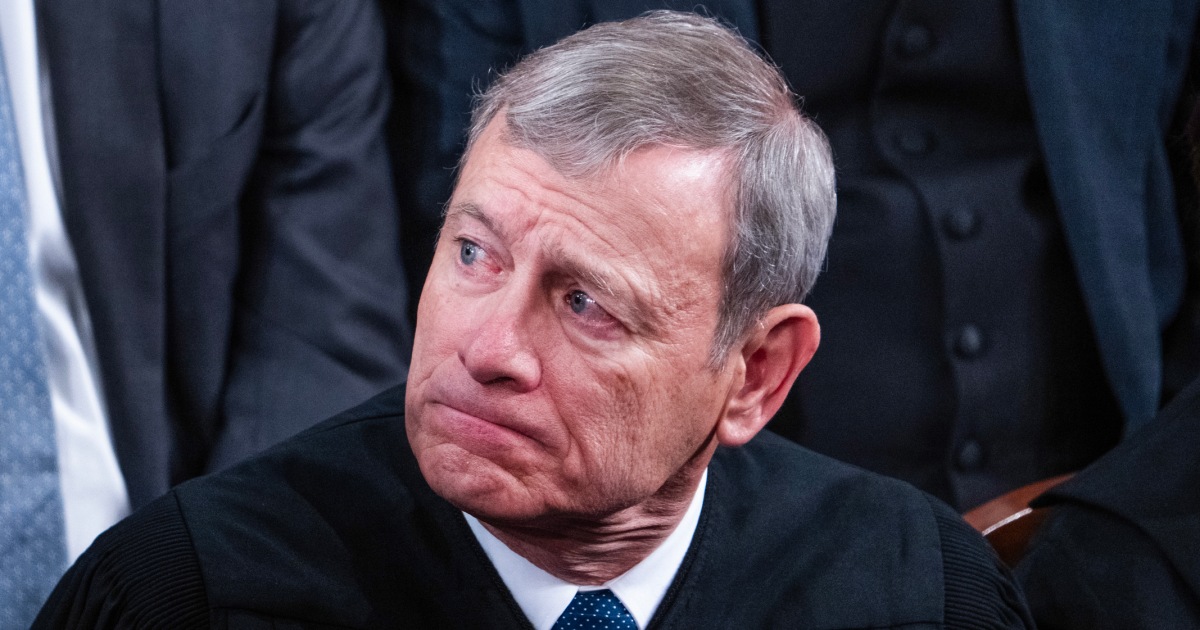
In remarks at a judicial conference, Roberts bemoaned what he characterized as the American public’s misconceptions about the Supreme Court.
Chief Justice John Roberts on Wednesday defended the Supreme Court from what he believes are misconceptions held by the American people that he and his colleagues are “political actors” who are making decisions based on policy, not law.
Roberts is a member of the court’s 6-3 conservative majority, which has moved federal law to the right on a number of weighty issues in recent years, such as abortion and gun rights.
The court has also in several cases weakened the landmark Voting Rights Act of 1965, including in a ruling last week that led to outrage and disappointment on the left.
Don’t assign a set number of seats. Whenever a justice dies, their seat dies with them.
Add one justice every two years, at the end of the first and third year of the presidential term. Every president gets to add exactly two justices per term. This timing pushes the decision as far away from an election as possible.
To further depoliticize the process, I would formally establish a “line of succession” for the court. This line would start with the chief judges of each of the 13 circuit appeals courts, then continue with every other judge in the appeals courts, in order of seniority.
Everyone in the line of succession has been previously confirmed by the Senate to their appellate court seats. To limit the games the Senate can play, I would not require an additional Senate confirmation if the candidate is one of the first 26 in the line of succession. The president can unilaterally elevate any of those 26 to SCOTUS (but, these are the oldest candidates available. They are at the pinnacle of their careers; they can be expected to serve terms measured in months, not decades. The president is not going to want to name one of these geriatrics.)
If a new justice hasn’t been added by the 18th/30th month of the president’s term, the next in the line of succession is permanently elevated to SCOTUS. This deadline keeps the appointment process at least 6 months away from an election.
The “line of succession” also suggests a way for the court to be apolitically reconstituted in case of a disaster. If the court falls below 5 members, the next in the line is automatically elevated.
Further, it provides a means for a case to be heard even if all sitting justices are conflicted and compelled to recuse themselves. If fewer than 5 members of the court are eligible to hear a particular case, the next in the line of succession is temporarily elevated for that case. In a case where SCOTUS ethics rules are under scrutiny, the case may be heard entirely by temporary members.
I like the way you think.