

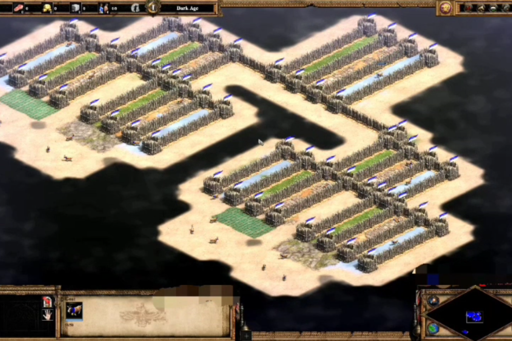
Let me tell you about a Microsoft AI researcher […] who recently spent quite a lot of time considering whether the legendary Microsoft real time strategy game Age of Empires II is conscious, and built a basic neural network within the video game using digital goats to prove his point. […]
De Wynter built an LLM within AoEII using goats. “The point of the paper is to formally show that we anthropomorphise too readily, and that sometimes the claims we make with regards to LLM capabilities are too strong,” he told 404 Media. “It’s not an easy task, given that ‘human-like attributes’ is a bit of an abstract term.”
Whilst I agree with the simple fact LLMs are in no way sentient, sapient or anything of the sort, I disagree with his argument. His argument boils down to: I can create this small part of a greater whole in a game, anything in the game isn’t sentient therefor the whole thing cannot be sentient.
But when we assume a human is sentient and look at the basic building blocks of our brains, the same equivalence can be made. Let’s say for our brains to do the brain thing all it needs is neurons (reality is much more complex, but for the sake of argument). I think nobody would argue the neuron itself is the bit that is sentient. And we even have a whole bunch of neurons working very similar to how they work in our brains together in small animals, we don’t consider them sentient. We can even simulate the neurons working together in a computer (even in AoE2 if it’s Turing complete) and we don’t consider the computer or any of the parts sentient. So what’s the difference?
I feel the difference is both scale and complexity. It isn’t the parts of our brain that are sentient, it’s the whole thing. And I’d even go further and say the brain as an abstract isn’t enough, it has to be a brain that has been filled with memories, experience, input and output. Then the whole is considered sentient. It isn’t the matter itself, it’s the actual processes that we consider to be sentient.
When one would simulate a human brain perfectly, but had not connected any input or output. Had not let it see the world, learn and experience, been given senses and time to processes them, then the result would probably not be considered sentient. A small baby or a person with severe brain damage or even brain dead isn’t sentient (at least not by most metrics). If the infrastructure is there, but the software isn’t running, it’s lacking the thing required to be considered sentient.
TLDR: Sentience is an emergent property of a large and complex system. Proving that a small part of that system isn’t sentient isn’t the same as proving the whole isn’t sentient. LLMs still aren’t sentient tho, I disagree with the reasoning, not the conclusion.
This is actually changing a fair bit in recent years, even to the point of: https://iai.tv/articles/new-studies-suggest-consciousness-exists-in-organisms-without-brains-auid-3597
Already for years we’ve determined that bees are sentient, and therefore likely all bugs: https://www.theguardian.com/environment/2023/apr/02/bees-intelligence-minds-pollination
Have you been, like… following the news? It’s good, soulless stuff (literally).
If your definition of sentient can include Age of Empires II then how can it possibly be useful?
Not the vanilla game with a limited map, and not on a 90s (or any existing) computer, and never in real time. But anything that can chain NAND gates to arbitrary size is Turing-complete, and we hve good reason to believe all atoms in the human brain obey laws of physics which can be simulated in a huge but finite Turing machine (there is still some debate over what we don’t undersrand at quantum level). In fact, nobody has proved we don’t live in a simulation because that’s impossible (like most religions by design and there are no practical consequences so this talk is just philosophical, don’t waste your time trying to “break the Matrix”). And if the underlying simulation of our reality is goats on a huge AoE server, would that make me and you not conscious?
To me this trivializes the word “sentience” to begin with. Which I do consider to be a reasonably meaningless word. Sentience requires a somewhat randomly defined definition–is sentience using tools? Crows and monkeys are sentient. Is sentience experiencing and expressing emotion/loved experience? My cat is sentient. Is sentience simply experiencing? Grass is sentient, it will respond predictably to external stimuli. Although grass also seems to communicate experiences, too. Freshly mowed lawn smell is grass “screaming in pain”, in the sense that it is the response to bodily harm, much like I imagine I’d scream in pain if my arm got taken off by a lawnmower. If we look at predictable responses to stimuli, I think one could make the argument that the planet itself is sentient, in that there are predictable geological and environmental results governments by the same physics that causes our brains to respond to stimuli. And then we’re just panpsychists.
The generally accepted definition of sentience seems to be requiring the use of tools of a certain complexity (often governed by the complexity of tools we have seen animals we don’t want to consider sentient use), as well as communicating on what we would consider a normal human timescale, i.e. ain’t nobody gonna sit and listen if a tree takes a week to say hello.
But this definition is pretty arbitrary, and can be easily misused. A bit like how “freedom” is somewhat arbitrary and means different contradictory things to different people. Your freedom to not get punched violates my freedom to punch you.
I disagree I think they can be. Just need to qualify the way you are using the term. Also no one actually just considers that our universe is very friendly to intelligence and consciousness there maybe much deeper reasons why. Like yea of course up is up, down is down, but maybe that is just exactly what consciousness needs to emerge? What we know as euclidean space is fundamental to life itself the reason it exists it is always going to happen. Or something idk im stoned.
Some conversations really should require all participants to pass a quiz before commenting. Sentience is one of those topics.
Okay, so… go on… Why troll and not educate?
Yeah, sure, just let me briefly outline the problem of sentience lol
I wasn’t criticizing the person I replied to, just anticipating they’re probably in for frustration.
Wait, by “some conversations,” you weren’t hinting at the very conversation you have been participating in?
If so, you realize that you could have dodged all of those downvotes with just a changed comment start of, “Agreed. In fact, […]” instead of proceeding immediately with the “some conversations”… right?! Communication is vital…
in retrospect, yes.
Trying not to worry about downvotes too much these days.
Sure, though I think concern over misinterpretation is worthwhile! Generally, votes are an indicator of that, I think.
They are, but it annoys me that people often interpret a comment by the votes, and I’m generally hostile towards herd behavior.
Fair, they can certainly hurt legit, uncommon thoughts… I use them as a minor guide but certainly not the end-all, and have spoken adamantly over the years about comments whose vote counts I strongly thought should be flipped in polarity (in both ways).