
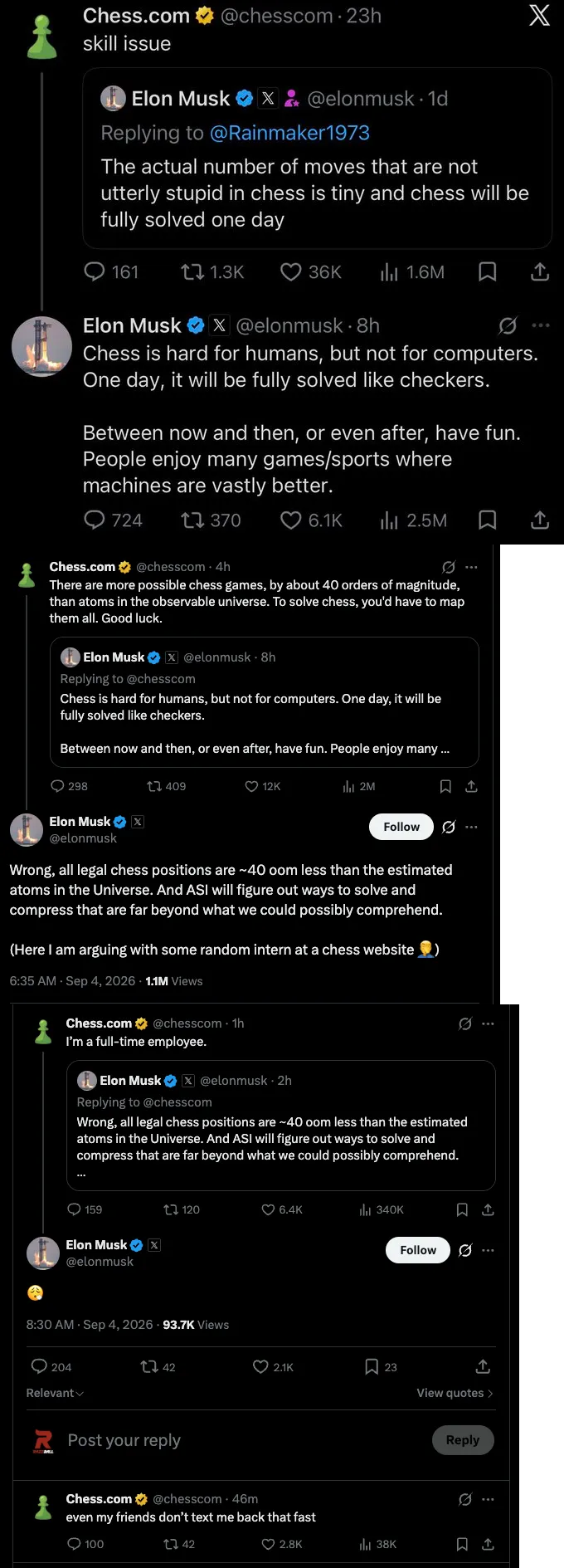
Transcript:
Elon: The actual number of moves that are not utterly stupid in chess is tiny and chess will be fully solved one day
Chess.com: Skill issue
Elon: Chess is hard for humans, but not for computers. One day, it will be fully solved like checkers. Between now and then, or even after, have fun. People enjoy may games/sports where machines are vastly better.
Chess.com: There are more possible chess games, by about 40 order of magnitude, than atoms in the observable universe. To solve chess, you’d have to map them all. Good luck.
Elon: Wrong, all legal chess positions are ~40 ooms less than the estimated atoms in the Universe. And ASI will figure out ways to solve and compress that are far beyond what we could possibly comprehend. (Here I am arguing with some random intern at a chess website)
Chess.com: I’m a full-time employee
Elon: (something-emoji)
Chess.com: Even my friends don’t text me back that fast
Ok;
This is the observable universe.
Not the entire universe, which we have no idea how large it is.
So the observable universe has 10^80 atoms or so. The number of possible moves in all possible chess games is supposed to be around 10^120. That number is called the “Shannon Number.”
According to this site.
yeah but how many of those moves are not stupid as hell, like my moves
Whether a move is stupid or not is Irrelevant.
You do need to remove the impossible positions, like pawns on rank 1
Removing stupid moves eliminates a lot of unnecessary to compute gamestates no?
No it doesn’t, you still need to know how to counter a stupid move
A mathematical model to solve chess would still need to recognise the move, calculate the advantage and disadvantage of the move and then discard. An algorithm would still need to do this for every move if it’s to be a compleat model.
Wouldn’t advantage and disadvantage just be a heuristic that’s useful for feasibly making computers that can win games of chess against humans, but by usual definitions of solved games, I’m not sure it would be useful? You’d still need a decision tree for every possible move the opponent makes for any state of the board.
So the chess.com account was right: 120 - 80 = ~40 oom