QR codes aren’t contained in some exotic filetype; it’s just Unicode text. They do usually contain a link, in practice; but the OP is saying that they should just encode a plaintext version of whatever is on the destination website, and also contain a link that the mourner can visit if they wish for images or interactive content.
Indeed, you can fit about 4,200 alphanumeric English characters (so, call it about 900 words) in the biggest QR code; long enough to fit more than just an obituary, and definitely more than you’d be able to chisel onto a headstone directly; though not long enough to fit an entire life story.
Though those are also the most fiddly to print and the most likely to be damaged beyond the built-in error correction’s ability to repair; to use the best error correction, you get about half that. And at version 3 or 4, which is the size you see most often, you only get at most about 100 characters. Which is why they’re usually just links.
So what you’re saying is that we need a better QR Code format
Because easily scanned data engraved in stone scannable by pocket supercomputer is pretty sci-fi.
I wouldn’t mind getting 900 words about someone in pure text form if it worked, and/or maybe a hologram using some sort of data saving format like pointillism (cloud of points forming a 3D image).
what you’re saying is that we need a better QR Code format
I’m not a precision optics guy, so I don’t know for sure, but it seems like the problem there is one of reliability. We’re talking about encoding digital data into an analog format, with enough error correction that it isn’t lossy, which limits our options; it needs to work in low light, at a distance, at any rotation, when a big blob of mud is stuck to it, when you’re standing off-center, when there’s reflections on it, when you’re moving, when it’s moving, in any color, with light and dark inverted, printed with any process, on any material, with any computer-connected camera, and it needs to work essentially instantly, in a standard format that enough manufacturers have agreed on that billions of phones could theoretically decode it without any additional hardware or software. Honestly it’s kind of a miracle that it happened once. I think the pixels need to be a minimum size, and it seems like Version-40 QR codes might be getting to around the limit of what we could reasonably expect a smartphone camera to reliably capture.
Because easily scanned data engraved in stone scannable by pocket supercomputer is pretty sci-fi.
Whoa, you’re absolutely right. I grouse and complain about QR codes replacing things like menus at restaurants, but if I could walk through a cemetery in 2126 and read a short obituary of someone who dies tomorrow, despite the mortuary being long since out of business, that would indeed feel sci-fi.
QR codes aren’t contained in some exotic filetype; it’s just Unicode text.
Exactly. That’s why:
Ok so include the URL in the text too.
is unnecessary.
I assume that the usual information of the deceased person, their name and dates of are still physically present on the tombstone, just the book of condolences and maybe an image or interactive content is on the web. Having only a QR code would be odd indeed.
Leave all the normal headstone stuff on the headstone. Also add a QR code, like these mortuaries are doing. But instead of making it just a URL to some sort of memorial page for the deceased, encode their obituary into the plaintext of the QR directly, and add a URL to the memorial page at the end of that text for people who want to see photos or sign a digital guestbook or whatever. That means that, even if the mortuary goes out of business and the URL no longer leads anywhere, the obituary is still readable by anyone with a smartphone.

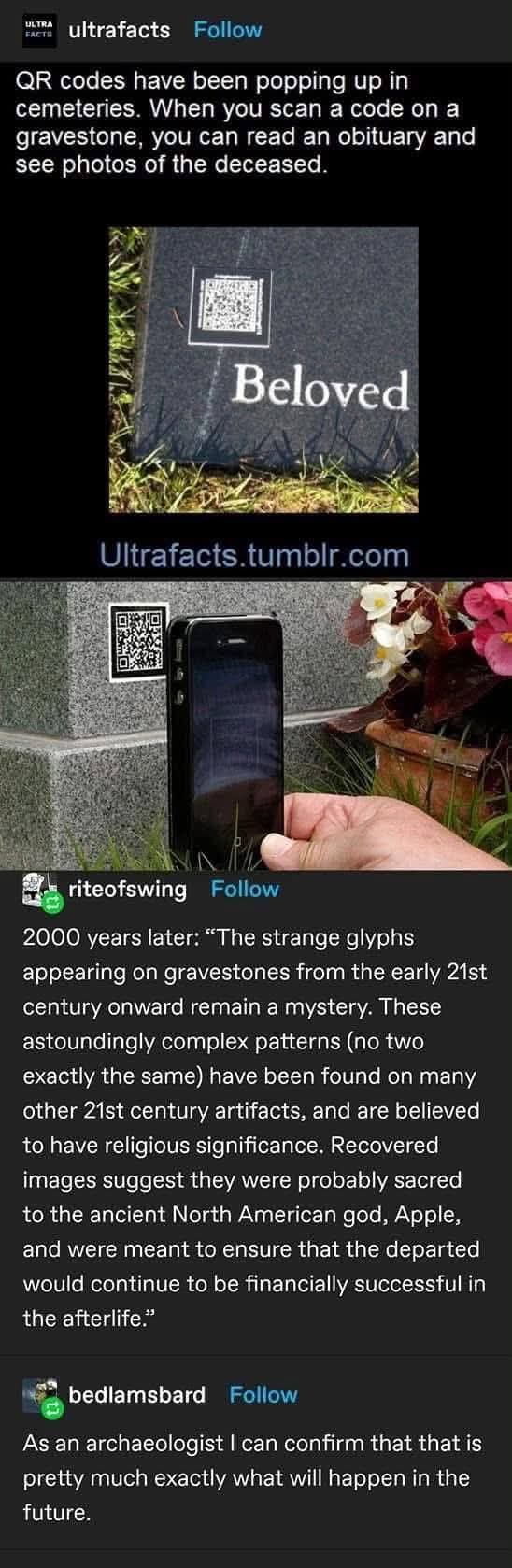
QR codes aren’t contained in some exotic filetype; it’s just Unicode text. They do usually contain a link, in practice; but the OP is saying that they should just encode a plaintext version of whatever is on the destination website, and also contain a link that the mourner can visit if they wish for images or interactive content.
Indeed, you can fit about 4,200 alphanumeric English characters (so, call it about 900 words) in the biggest QR code; long enough to fit more than just an obituary, and definitely more than you’d be able to chisel onto a headstone directly; though not long enough to fit an entire life story.
Though those are also the most fiddly to print and the most likely to be damaged beyond the built-in error correction’s ability to repair; to use the best error correction, you get about half that. And at version 3 or 4, which is the size you see most often, you only get at most about 100 characters. Which is why they’re usually just links.
So what you’re saying is that we need a better QR Code format
Because easily scanned data engraved in stone scannable by pocket supercomputer is pretty sci-fi.
I wouldn’t mind getting 900 words about someone in pure text form if it worked, and/or maybe a hologram using some sort of data saving format like pointillism (cloud of points forming a 3D image).
I’m not a precision optics guy, so I don’t know for sure, but it seems like the problem there is one of reliability. We’re talking about encoding digital data into an analog format, with enough error correction that it isn’t lossy, which limits our options; it needs to work in low light, at a distance, at any rotation, when a big blob of mud is stuck to it, when you’re standing off-center, when there’s reflections on it, when you’re moving, when it’s moving, in any color, with light and dark inverted, printed with any process, on any material, with any computer-connected camera, and it needs to work essentially instantly, in a standard format that enough manufacturers have agreed on that billions of phones could theoretically decode it without any additional hardware or software. Honestly it’s kind of a miracle that it happened once. I think the pixels need to be a minimum size, and it seems like Version-40 QR codes might be getting to around the limit of what we could reasonably expect a smartphone camera to reliably capture.
Whoa, you’re absolutely right. I grouse and complain about QR codes replacing things like menus at restaurants, but if I could walk through a cemetery in 2126 and read a short obituary of someone who dies tomorrow, despite the mortuary being long since out of business, that would indeed feel sci-fi.
I mean, it already does.
3D ASCII art?!? That’s amazing!
Exactly. That’s why:
is unnecessary.
I assume that the usual information of the deceased person, their name and dates of are still physically present on the tombstone, just the book of condolences and maybe an image or interactive content is on the web. Having only a QR code would be odd indeed.
I don’t think anyone is suggesting just a QR code.
What’s then the point @LodeMike@lemmy.today is trying to make?
Leave all the normal headstone stuff on the headstone. Also add a QR code, like these mortuaries are doing. But instead of making it just a URL to some sort of memorial page for the deceased, encode their obituary into the plaintext of the QR directly, and add a URL to the memorial page at the end of that text for people who want to see photos or sign a digital guestbook or whatever. That means that, even if the mortuary goes out of business and the URL no longer leads anywhere, the obituary is still readable by anyone with a smartphone.
That’s my guess.