The bipartisan legislation was crafted in both chambers and must now pass the House. It seeks to build more homes and prevent large investors from out-bidding families.
The Senate voted overwhelmingly on Monday to pass a sweeping housing affordability bill aimed at lowering costs, putting Congress on the brink of a rare bipartisan victory in Donald Trump’s second term.
The vote was 85-5.
The legislation, which makes it easier to build homes and slaps limits on Wall Street investors from buying up houses, now goes to the House, which hopes to vote on it in the next few days. Then, it would go to Trump’s desk to be signed into law.
From another comment - didn’t do my own fact checking that time
I have so little faith in our government that I genuinely assume there is something deeply wrong with this legislation and it’s actually unharmful AF.
Anyone know what it is or is this genuinely semi-good newa
That it’s gotten this far with this many votes means that investment firms have already placed language into the bill that will let them continue to buy up houses by completing a few additional low-effort steps.
Last I heard the limit on ownership was 100 units, but it may not have been very aggressive at avoiding companies from splitting off into 1000 LLCs or other such nonsense.
That’s what I’m guessing, that each LLC is only allowed a certain number of units, or there’s a limit on the number of different types of units which will only lead them to re-name each type of unit to something else. It’s no longer “single family homes” but “one unit housing with land”. Or it limits the amount of “affordable housing” they can buy, but then they just change what’s affordable, or only build luxury houses - like everyone wants affordable, economical cars these days, but all you can buy are expensive, gas-guzzling SUVs.
This does not appear in the HR bill. Corporations are not allowed to purchase any new single family residences (which can have up to 2 units) at all. They’re not forced to sell what they currently own, but can’t buy up more.
single family residences [SFRs] (which can have up to 2 units)
so i’m going to admit i have shit understanding of the residential real estate market. kind of like congress, because how many congresspeople worked in residential real estate. so i picture they went and said “hey, let’s keep duplexes as SFRs” (i don’t know why, probably because they think they have more in common with SFRs that are one unit and less with condos, which kind of makes sense to me.) someone who can afford to go into the bank and ask for a loan with a straight face is probably a better bet to explain the residential real estate market though.
edit: shit, posted and forgot to take all the [oh my gods the government is insane you have to go insane to understand the government] ranting out. edited.
I think a bunch of homes have what’s often called a Mother-In-Law suite. Effectively a separated section or the house, or sometimes even a separate building in the same land parcel, where an older relative, or grown up child might live, but with a touch more privacy. Nothing to stop those being rented out, either.
So this would prevent those getting bought up. I believe you can get up to a 4 unit with certain types of government backed home loans.
yeah, those MiL suites are called ADUs (i think Accessory Dwelling Unit, essentially an Accessory Unit that is also a Dwelling. I’m making up the name for the acronym but i’m sure i’ve got it) when they’re not attached. Laws have gotten a lot less stringent about building those. i’m going to go dream of tiny homes for a bit now.
i used to live in utah and those MiL suites were called “we finished our basement”
How does it affect multi-family housing (e.g. apartment buildings)? And is this considered a problem, or is it only buying SFH that is the issue?
Doesn’t. This only refers to 1-2 unit structures.
How convenient.
Not sure why you expected apartments to be covered by a bill addressing home ownership.
hey, so it might help to take a dive into residential zoning law. figure out what you need to do to legally build an ADU without a permit in your locale and you should have figured out enough
Hah, I was about to comment that there’s no doubt some fine print in there that does still allow a shell company to buy, so while the book looks great, the story is shit!
Is that actually true or are you just assuming this?
I’m lazy so I asked an llm to analyze the text of the bill. I am Jack’s complete lack of surprise:
Short answer: Based on all available full‑text versions of H.R. 6644 (the 21st Century ROAD to Housing Act), the bill does not contain any language that prevents institutional investors from using shell companies, LLC chains, or affiliated entities to evade the 350‑home ownership cap. There is no beneficial‑ownership look‑through, no aggregation rule, and no anti‑evasion clause anywhere in the statutory text.
Yikes. I was speculating based on how easily this is being pushed through…
I did the same. Dueling LLMs. (Gemini Pro for this one.)
🤖 🤖 🤖
Here are the specific safeguards in the text preventing companies from using shell companies or subsidiaries to bypass the cap:
1. The “Aggregate” Rule
The legislation establishes a cap of 350 single-family homes. Crucially, the text defines a “large institutional investor” as any for-profit entity that, “alone or together with other entities,” holds the homes in the aggregate.
If a parent company sets up ten different LLCs and puts 340 homes in each, the law aggregates them. For regulatory purposes, the parent company owns 3,400 homes and is in blatant violation of the ban.2. A Broad Definition of “Investment Control”
The bill uses a sweeping definition of “investment control” to catch indirect ownership. An entity is counted toward the 350-home cap if it: Owns the home directly.
Has primary investment or management decision-making authority over the home.
Directly or indirectly controls the owning entity (this catches general partners, managing members, investment managers, and advisors). Directly or indirectly owns a significant equity stake (usually defined as over 25%, though explicitly excluding genuinely “passive” investors).
For example: If you own 200 homes through Subsidiary A, 100 homes through Subsidiary B, and you act as the General Partner on a real estate syndication holding 60 homes, your aggregate count is 360. You are over the cap.3. A Loophole-Free Definition of “Purchase”
Companies cannot use corporate restructuring to sneak homes into their portfolios. The bill defines “purchase” to include any transfer or acquisition of a single-family home. This includes acquiring homes through:
Mergers and acquisitions (buying a company that owns homes counts as buying the homes).
Bulk portfolio purchases.
Foreclosures.
Construction.4. Severe Financial Penalties
The financial penalties are designed to be punitive enough that testing gray areas isn’t worth the risk. Violations carry a civil penalty of up to $1 million per violation or three times the purchase price of the home, whichever is greater. Buying a $400,000 house in violation of the cap could trigger a $1.2 million fine.
It seems this is mostly covered: controlling the financial manager or over 25% of the entity that controls the homes counts as the company owning the house. But those first level entities wouldn’t be able to buy any more, any way.
Ah a fellow cynic. I also have no faith this will solve the problem. My issue is that this is all coming way too late. I personally think they’ve gotten all the easy money out of the system and realizing that the housing market has hit a temporary peak. Now it’s safe to pass this bill and allow politicians to get brownie points. Atleast in my area, I’m hearing of way less stories of families being beat out by cash offers 200k over asking. Which was the norm during covid.
It’s fine if they get political points for doing good things. That’s how it’s supposed to work.
This should help.
A bigger solution would be more real mass transit in cities. This Atlanta, LA, Texas traffic is fucking stupid and just one more lame won’t fix anything. Mass transit and walkable villages bring high density housing that people actually want. And they reduce traffic and make the world a better place for everyone.
Guess what, if you’re just visiting a city, or you want to go to a concert or a sporting event, mass transit still helps you even if you’re in a car. Shouldn’t be hard to see why.
Yeah the non-cynic in me agrees with you, but I shoved him in a box for that comment, and for this one. The thing that doesn’t sit well with me is that this bill is coming 6 years after the problem really became an issue. With that and the close proximity of midterms, it just seems like some corporate daddy with enough swing has gotten their fill of single family housing and has decided to let a bill be passed that doesn’t affect their current enormous backlog of “investments”. There’s also a crazy man that lives in my crawlspace that believes that this is all because community credit unions started bidding on homes in low income neighborhoods and selling them back fo people who lived there /have lived in that neghboor hood. He’s bad with specifics (radon and rats it from the crawlspace accommodations) but I think it was in Detroit or Chicago?
At anyrate, I would sure love a solid passenger train system that wasn’t getting fingerbanged by the elephant hand that is the US freight system.
Huh? Seriously?
But does it do anything requiring them to divest the properties they currently own?
Nope. Private Equity firms have already snapped up all the houses they want.
They could have fixed this easily with taxation. First homesteaded homeand anything on a VA loan is tax free, second home is taxed normally, third home owned is taxed at +5%, fourth +10%, fifth +15%. No exceptions, no deductions. Not even banks are exempt … want to foreclose on a house? Pay taxes on it. That would fix things instantly.
The legislation, which makes it easier to build homes
The goal is to just keep building more units forever, which will make developers very happy. It’s also got a big carve out for modular housing, which the tech sector has been pushing for a long time. So, get ready to live in the pod. We’ll have to see about whether the next Agg Bill has us eating the bugs.
They’re also giving a bunch of power to the EPA to bigfoot state environmental standards. So that’ll be extra fun.
Text Here in case anyone is curious.
Funnily enough, I can’t find anything in this bill that restricts the ability for investor aggregated housing.
Giving Trump a politically popular win in the months leading up to a pivotal election certainly is a choice. Also, if the GOPedos are supporting this it is probably functionally useless or worse. Are Democrat strategists hyper-inbred sewer mutants who finished bottom of their class and/or do they show up to work wearing MAGA hats?
They’re passing a law allowing 100% anonymous shell companies to get around this
if both parties voted for this, I’m curious to hear what the loopholes are for the rich to get richer off of it.
Biggest one seems to be: this does nothing to force companies to divest their current ownership of single family homes.
They can just continue to sit on them indefinitely.
And since each company can own 350 homes, they’ll just spin up a new subsidiary that “outsources” property management to the original company and keep buying.
Does the bill mention ownership or beneficial ownership? Because the difference in terms might rule out subsidiaries.
Short version: if congress makes a law and you set up a structure to avoid whatever reporting requirement or income limitation or ownership limitation the law put in, you’ve only got a few years before you’re getting screwed by the feds.
Not a lawyer but I’ve seen this in titles 18 and 26 a bit too often.
It does mention aggregate, if Gemini Pro is to be trusted.
Thanks. Gemini pro 2 is not to be trusted though.
The bill mentions nothing of a 350 limit, where are you pulling that number?
And companies can’t buy more single family homes at all. So, no, they couldn’t do that. Only way to get more is by building them themselves and not selling - which is not the business model that builders use.
Edit: 350 is the number that could be used to define a large institutional investor, but the number is in aggregate, so spinning up a subsidiary doesn’t change the number it would own.
According to the article, (which is very light on details and rambles on about the political implications instead - thanks corporate media) the restrictions are just for single family homes. So this will help stabilize housing prices for people who are already well off, and instead push these equity firms to focus on cheaper housing like apartments, so that the working class can be squeezed even more.
Yes… they’ve reserved that right for themselves and their banker buddies.
Yeah I no longer give a fuck.
Since the economy was destroyed none of us could afford it now anyways.
I plan on retiring in a ditch somewhere once the exhaustion of being overworked reaches its peak.
Since the economy was destroyed
glances around at the state of the US economy
Idk, man. Looks like it’s still chugging. Traffic on the streets. Money changing hands. Plenty of new builds in my own neighborhood. Lots of new cars on the road. Airplanes passing overhead every twenty minutes. Hell, we just had a big fire at the railroad junction near the Houston ship channel and that doesn’t happen unless lots of trains and ships are running past each other.
If you want to see a flattened economy, check out Cuba right now. Or Gaza. Hell, check out West Virginia, if you want to see something local. The end of the coal industry is hitting them like a sledgehammer. Louisiana also really stinks right now, with so much of their refinery industry idled. But California? Florida? New York? Texas? They’re all choking on the endless volumes of Tech Sector cash we’re pumping in.
Anecdotal. I’m glad you live in a wealthy place. New cars are generally leased, and usually irresponsibly. Airplanes for travel, shipment of goods, leisure or deportation?
Obviously Gaza has no economy, its been turned into a wasteland.
The tech sector being whom exactly? I know quite a few engineers who have been unemployed for about a year or so. Are you talking about the skeleton crews they’ve kept? Or maybe the LLM snake oil salesman? The billonares or business owners themselves? Or do you mean surveillance state datacenter construction?
The tech sector being whom exactly? I know quite a few engineers who have been unemployed for about a year or so.
I know far more employed engineers than unemployed ones.
I’m glad you live in a wealthy place.
None of this is unique to a single corner of the country.
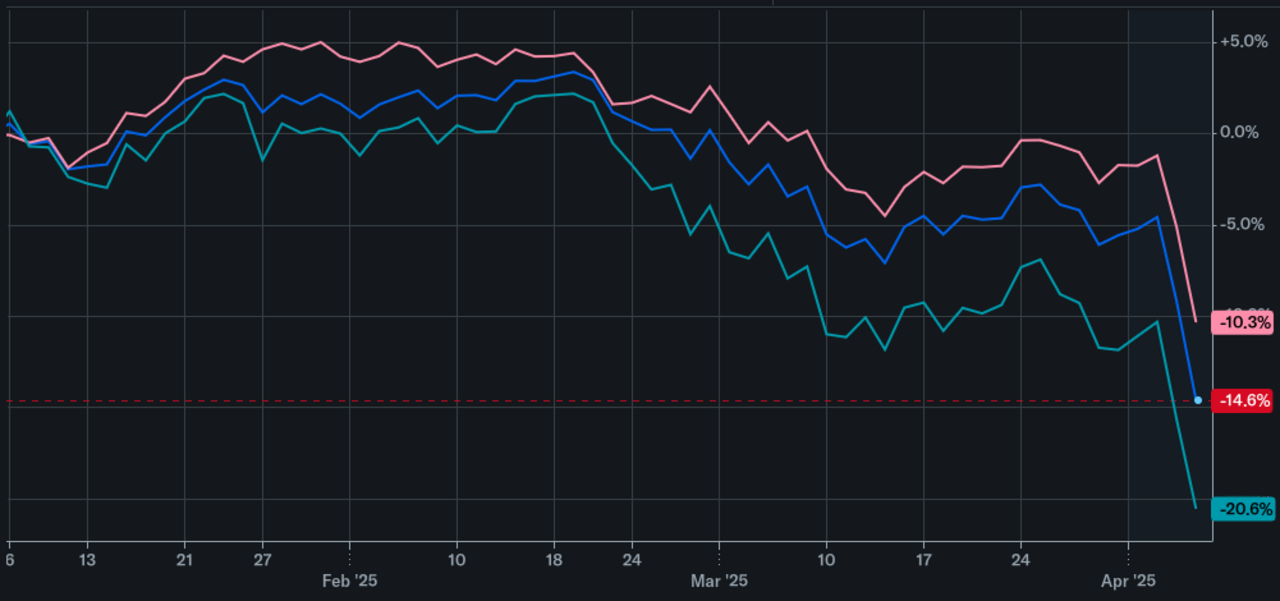
Maybe you didn’t see that label-less chart of 3 different colored lines that go down, can’t argue with that /s
I’m not sure why you’d want to advocate for Republicans fucking the economy and stock market simultaneously
You think that’s the chart for S&P, Dow, and Nasdaq?
To be sure - the stock market is not a good measure of economic health. Nor do I disagree that what you and the people you know are experiencing as your lived experience. But whatever that is, it’s some historical cherry picked chart that is not YTD performance of the major indexes.
That’s exactly what it is. Nowhere did I say it was current. Perhaps this will refresh your memory:
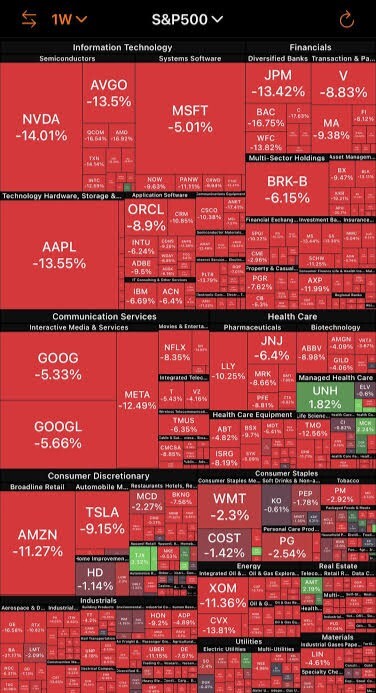
It has bright colors, maybe what’s left of your brain can figure it out

This is such a small step, but at least it’s a step. If politicians actually want to solve the problem, they have to prevent any legal entity from owning many single family homes. Make the limit something like 2, so a family can still have their cabin in the woods and their city home or whatever. So that you don’t flood the market and yank grandmas retirement plan of selling her home and moving to a retirement community start off big. For example starting this year no entity can own more than 100 homes. Next year it’s 90, then keep cutting by 10 a year till you get to 2. This will free up massive amounts of homes over the next 10 years. To plug the loophole of just spinning up LLCs to own houses, make it so corporations can only own multifamily residential of 4 or more units. Penalties need to have teeth as well. $100k fine per home initially, scaling up to seizing the property and selling to the highest bidder.
This will have the added effect of also preventing builders from just sitting on new builds till they get their ridiculous price. New builds will go to auction if not sold within a year of passing their certificate of occupancy.
There’s a lot more that’ll need to happen to keep rental apartments affordable as well, but getting corps out of single-family is a great start.
In parallel, initiate a scaling vacancy tax for both commercial and residential properties that rapidly ramps up the longer a property is left vacant.
i mean federal law isn’t going to address LLCs because it considers Limited Liability Companies to be partnerships. LLCs are a state thing
That article is trash.
It offers no details about what the bill actually says or does, just what the senators say it does. It’s only reporting the horse race aspects of it’s passage, which is the least important part.It’s only reporting the horse race aspects of it’s passage, which is the least important part.
That’s because you can go right now to the legislation they hyperlinked if you want to know the text of the bill. The fact that the article is reporting on the politics surrounding a bill and giving a broad overview of what it does doesn’t make it “trash”; it makes it not what you’re specifically interested in, which is fine.
Which part of the 381-page document are you upset they weren’t quoting from or deep-diving into?
Anything that verifies the claims the senators are making.
If you’re a reporter trying to inform people about a bill that passed, you should have people read it and find out what it actually does, instead of just quoting the people who probably passed without reading it themselves.My reading of the bill is useless, because I’m not a lawer, or trained in reading these sorts of legal documents. I can’t tell what’s important or not. And I don’t have a week/month to understand it.
Anything that verifies the claims the senators are making.
The claim they cited from Republicans is just that it pushes back regulations, which is, like… Are you seriously asking for proof of that from a 381-page bill voted on 85–5 by a Republican-majority Senate? Is that some kind of specific, deeply controversial claim that needs interrogating in an article for a general audience? And the claims from Warren and Trump (for which their own agreement itself can be used as evidence) are that it pushes back on corporate ownership of houses:
The legislation would approve a series of funding and grant programs for constructing new homes. It would slash red tape and empower local governments to expedite reviews to build more housing. And a key section titled “Homes Are For People, Not Corporations” would restrict any “large institutional investor” from buying single-family homes.
At which point, you, a functioning, literate adult, can go to the bill’s table of contents, find that it’s Sec. 1001 (pp. 360–379), and read through it. If you’re looking for an in-depth legal analysis: congratulations. That’s cool. I hope somebody like LegalEagle makes one for you. Here’s a summary of the bill’s sections from the US House Financial Services Committee if that helps you at all.
That again doesn’t make this article “trash”; it means you’re looking for something deeper than what most people are.
If you want to know how to learn Legalese, here's how I did it.
So I’ll be honest, it can be worth the time to learn to read this shit but it takes time and effort. It’s hard. You’re learning a new dialect of English. Most folk I know call it Legalese or Lawriiwook. The Cornell Law Library has a great online, free collection of articles about legal decisions. Go read the important ones: Plessy v. Ferguson, Dred Scott v Sanford, Brown v. Board of Education, hell any decision authored by Learned Hand (what an awesome name, right?), just one a day reading the decision and then their article on it until you feel like you’ve got a grasp on it. The first week, read the article, then the decision, then the article again. Trust me, it’ll help. Keep a legal dictionary nearby. And a latin one.
My favorite teacher in B School told me that’s what law school was like. Then he saw that I was enjoying it and dissuaded me as kindly and firmly as he could. Asked all the judges and lawyers and sinners in the family and they agreed with him.
Perhaps some people want to know what their legislator in particular is saying and that is valuable news to them.
You can verify the text of the bill yourself, but you can’t get that quote yourself.
What if I told you that the news exists so that not everyone on the planet has to research everything?
Since you’re on a whinge: look up Steve Vladek. Personal friend, great legal analyst. If he hasn’t written about this yet, it’ll be up tomorrow or the next day.
What the fuck kind of response is this? “The news” (at least general audience news outlets like NBC) exists so that people can have a summary-level understanding of current events without having to research everything. This article provides a summary-level understanding of current events. If you want more than that, to actually go in and interrogate the exact text of the bill, what if I told you that legal analyses exist for that?
I don’t bitch and moan every time a newspaper article talks about a scientific discovery and doesn’t get deep into the weeds of the methodology and shit. That’s just how newspapers and news outlets work.
This will not increase the housing supply. In fact, it should theoretically decrease construction of housing, by reducing the demand for it. But it would be much harder for Congress to address the root of the problem, and big companies make an effective scapegoat.
They must be insider trading with contractors now. Here comes the no bid contracts for companies owned by their family members and oligarch shareholders . This will also be used to union bust because of “cost”
Does it exclude private equity?
What happened, did some repugnican’s kids try buying a house and found out how much of a nightmare it really is?